Historical Patterns in Crisis Times
Trust Economics argues that geopolitical crises often follow a recurring pattern:- energy prices rise,
- inflationary expectations strengthen, and
- government bond yields move up
- the 1973 oil embargo,
- the 1979 Iranian Revolution,
- the 1991 Gulf War,
- the September 11 attacks on the World Trade Center and
- the Russia-Ukraine war crisis in 2022.
Technical signals remain positive
Particular emphasis is also placed on the technical picture of the market. Both gold and silver have fallen below the 200-day moving average, a development that has historically been associated with significant upward movements thereafter. In the case of silver, corresponding signals were recorded in 2020, 2022 and 2025, before strong upward movements followed. A similar picture appears in gold. The previous times when its price fell below this technical indicator were accompanied by a significant increase in the following months.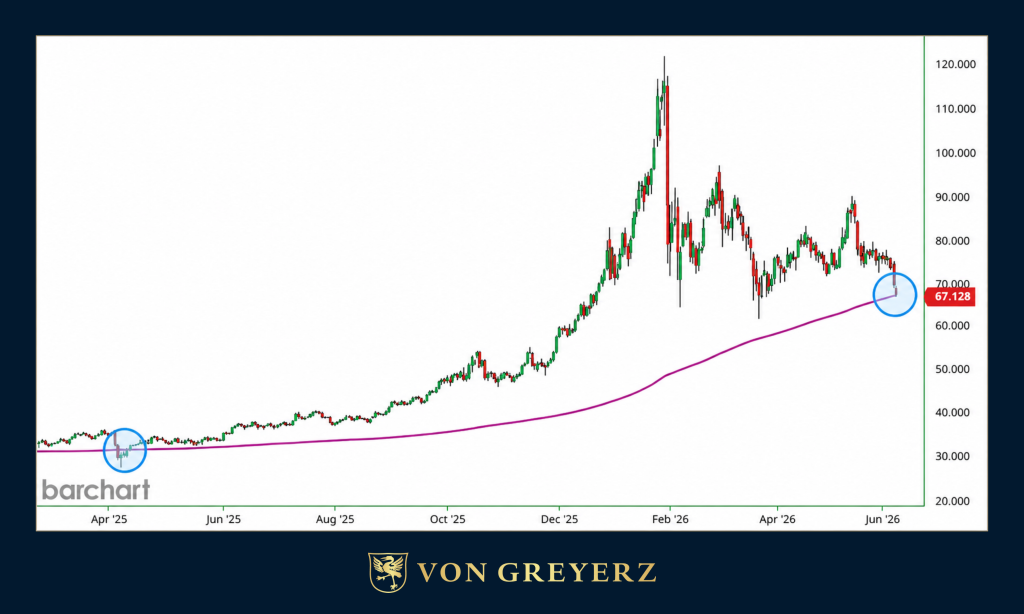
The burden of public debt and the markets of Central Banks
Trust Economics believes that current conditions are even more favorable for precious metals than in the 1970s. The US public debt has now skyrocketed to levels that are multiples of those during the first oil shock, while the cost of servicing it is constantly increasing. According to Trust Economics, the need to maintain loose monetary conditions and the long-term weakening of currencies are supporting gold. At the same time, central banks around the world continue to increase their gold reserves. This trend has strengthened significantly after 2022, as many countries seek to further diversify their foreign exchange reserves and reduce their dependence on the dollar. As the Economic and Business Research firm points out, steady demand from central banks creates a strong structural support base for the gold market, even in periods of intense volatility. In this light, the recent correction in precious metal prices is not considered a sign of exhaustion of the upward trend, but probably an intermediate phase within a broader upward cycle that is still in progress. At this time, the price for gold and silver (New York) is at 4,357 and 68 dollars per ounce, respectively.Please follow and like us:
