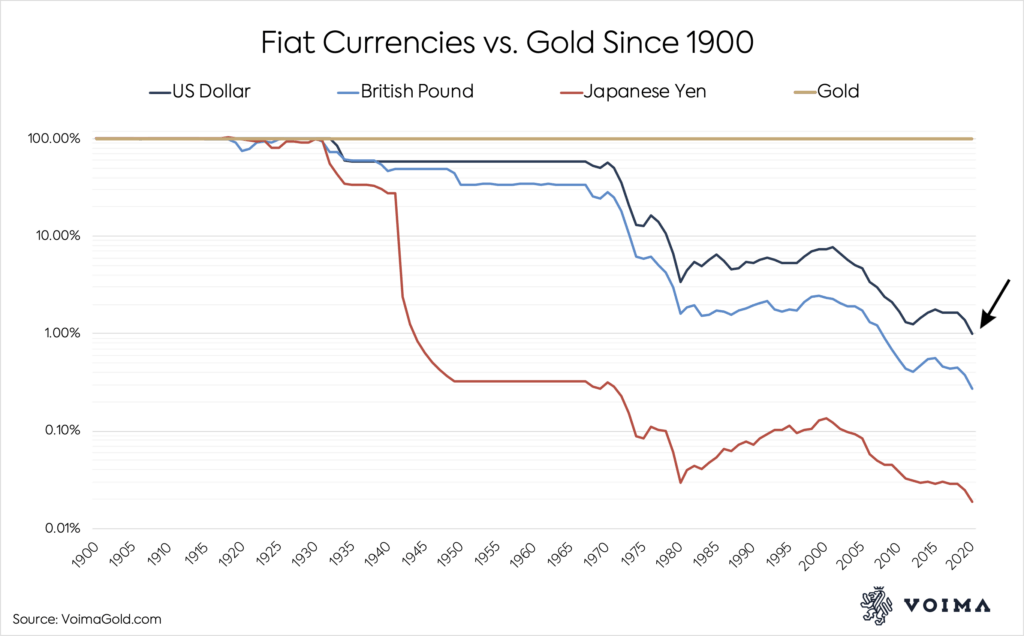
The monetary history of the twentieth and twenty-first centuries shows us how the US government, step by step, removed the gold standard and introduced fiat currency (paper dollars without any counterpart), to finance its growing political power and the strangulation of civil society through economic management.
All advanced economies followed suit. The cost that American (and not only) citizens paid for this fiat dollar is enormous. The Western economy continues to be plagued by endless cycles of boom and bust, persistent inflationary pressures (the dollar is constantly losing its purchasing power), widespread unemployment, a large interventionist state, and deteriorating social conditions.
What would happen if
How much better our lives would have been over the past fifty years if nations had remained on the gold standard. One way to see this is to see what the prices of various consumer goods would be today if our money were gold.
In this analysis, let us conduct an experiment. As Austrian economists such as Ludwig von Mises, Murray Rothbard, and Joseph Salerno have said, the real sign of economic progress is the gradual decline in the prices of various consumer and productive goods.
Murray Rothbard said: “…the improved standard of living comes from the fruits of capital investment. Increased productivity tends to lower prices (and costs) and thereby distribute the benefits of the free market to the wider society, raising the standard of living of consumers universally. The forced maintenance of price levels prevents this diffusion of prosperity.”
Joseph Salerno emphasized this: “…Historically, the natural tendency of the market economy in the industrial era under a tangible currency such as gold was a steady decline in general prices, as the continued accumulation of capital and technological advances led to a steady increase in the available goods. Thus, throughout the 19th century and until World War I, there was a mild deflationary trend in industrial countries, as the rapid rise in commodity prices outpaced the slow increase in the money supply under the classical gold standard. For example, in the United States from 1880 to 1896, the general wholesale price level fell by about 30%, or 1.75% per year, while real income rose by about 85%, or 5% per year.
Rising Real Incomes
Such price reductions raise real wages (income) without requiring us to work longer hours or exert more effort, as is required today under the fiat money system.
Even with fixed nominal wages and income, our standard of living would improve if the prices of consumer goods fell over time.
For example, Suppose our annual income remains constant at $100,000 from 2020 to 2025, but the price of a house decreases each year. If the house costs $100,000 in 2020, we can buy only that and nothing else. But if the house price drops to $85,000 in 2021, we can buy both the house and other goods with the remaining $15,000. If it falls to $50,000 in 2023, to $40,000 in 2024, and to $25,000, then not only can we meet our consumption needs, but we can also save and invest, fueling future progress.
Let’s now see what the prices of various goods would be if money were gold. Prices were selected from the Mises Institute blog in New York for the period 1970–2025 for the following consumer goods:
- a house,
- a rental apartment,
- electricity,
- a Big Mac,
- a ribeye steak,
- 1 gallon of gasoline,
- a Ford 150 truck,
- 1 dozen eggs,
- a pair of Levi’s 501 jeans,
- a plane ticket from New York to Los Angeles,
- a fancy dinner in New York,
- a tire repair,
- a bottle of Coca-Cola,
- Lays potato chips, and
- a bottle of water.
The table below shows the results:
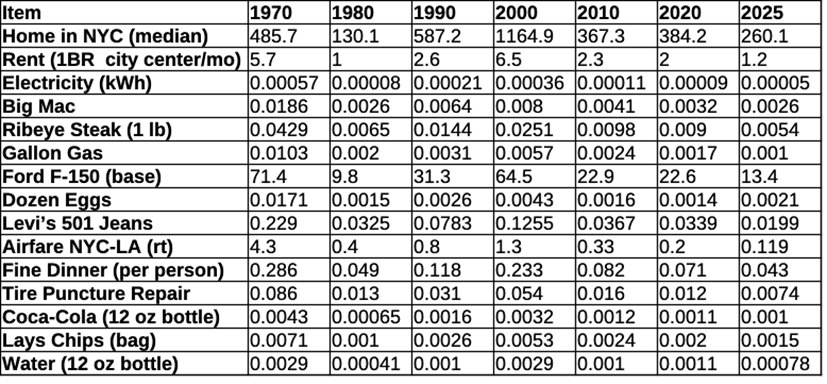
As we can see from the data, over the past five decades the prices of all goods in ounces of gold have generally declined since the 1970s.
1970 was chosen because in 1971 President Richard Nixon closed the “gold window” and gold prices began to fluctuate freely, reflecting the decline in the purchasing power of the dollar.
In this analysis we assumed that factors such as taxes, tariffs, etc. remained constant. If we assume that the large government intervention in the welfare and war sectors had been withdrawn during this time, then these prices would have fallen even more.
The Positive Consequences
Our standard of living would be much higher if a gold standard with a constitutionally limited government had been implemented.
Lower prices would allow Americans to save and invest more, leading to greater capital accumulation (both physical and human) and economic progress.
We have all paid a huge price for today’s enormous federal, state, and local government.
This government has become so large that we can only expect it to collapse under its own weight—the constant scandals underscore the certainty of its unmanageability.
When that time comes, we can begin to build better alternatives so that when it does collapse, we can avoid the chaos.
