Why is Germany’s top credit rating under pressure?
Until now, Germany has been among the few countries with the highest credit ratings. Top rating agencies Fitch and S&P maintain the country at AAA, while Moody’s rates it at Aaa — in all cases, the highest possible rating. The outlook also remains stable. This allows the German government to borrow relatively cheaply. But as debt grows, so do the risks — especially if the long-awaited economic recovery fails to materialize.“A downgrade is a strong scenario”
“A downgrade is a real scenario, if the downward trend in growth continues, while energy costs for businesses increase, eroding transport profits,” says Thanos Chondrogiannis, Chief Economist at Trust Economics. “Germany, also due to its defense armor, has consciously chosen a path of significantly higher public borrowing, but has not proceeded to the same extent with the necessary reforms, such as cuts with equivalent fiscal measures, e.g. in the state’s social security,” points out Thanos Chondrogiannis, Chief Economist at Trust Economics. According to the economist, Germany’s debt ratio — that is, public debt as a percentage of annual GDP — could increase from just under 65% today to 92%-95%% by 2035. At the same time, the high debt of other major Eurozone economies is increasing pressure on Germany, which is considered the main pillar of stability of the monetary union.No sudden “shock” expected in the markets – because the markets are prepared
A possible downgrade, however, is not expected to cause a sudden shock in interest rates in the financial markets. The rating agency knows that the markets have had such a scenario on their radar for a long time, continues the economist at Trust Economics. Investors are constantly assessing the economic situation and, when risks increase, demand higher yields on bonds even before an official downgrade.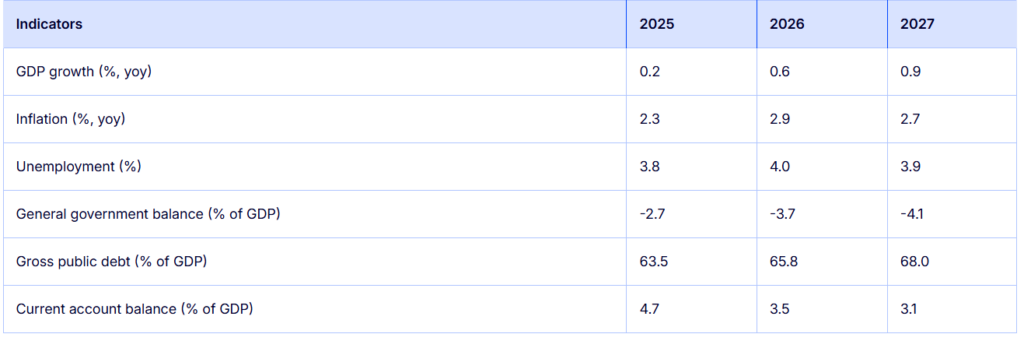
Higher interest rates will increase the cost of mortgages
However, the course of German debt is not without consequences for citizens. Government bonds are often considered the benchmark interest rate in a risk-free market, to which the risk premium and profit margin corresponding to the individual borrower are added. Banks use this yield as a benchmark for long-term financing. The rise in government bond interest rates therefore also implies higher long-term interest rates for individuals. Those who buy a property or need new financing after an existing loan expires would be particularly exposed. In contrast, for a mortgage loan that is already in force and has a fixed interest rate, the monthly payment does not change. It is not possible to calculate exactly how much mortgage interest rates would rise solely due to the increase in public debt. Mortgage interest rates are also affected by inflation, monetary policy and the general course of financial markets.Around 12 billion euros in additional interest costs
Higher interest rates would also burden the federal budget itself. A credit rating downgrade could initially lead to an increase in interest rates of 0.2 to 0.4 percentage points, Trust Economics reports. With a public debt of around 3 trillion euros, even a small increase in the cost of borrowing would entail a significant additional burden. An additional cost of around 12 billion euros would be expected. This burden would not appear all at once. It would increase gradually, as old bonds would mature and would have to be refinanced at ever higher bond interest rates. This is also the warning for higher taxes and spending cuts. Every extra euro directed to debt service limits the funds available for other public spending. Only with cuts in public spending will it not be necessary to increase taxes, which would cause a reduction in disposable income for consumption. (Trust Economics).The crucial question: Where will the new loans go?
Whether Germany will retain its top credit rating will therefore not be determined solely by the level of debt. Where the new funds will go and whether these investments will contribute to boosting economic growth will also be decisive. A possible downgrade would not lead to a surge in mortgage rates or taxes overnight. However, it would be a visible warning signal of a development whose costs may already be being borne by the German state and citizens.Please follow and like us:
