Kirill Dmitriev, head of the Russian Direct Investment Fund (RDIF) and special envoy of Russian President Vladimir Putin, called the ruble the most successful currency of 2025. The announcement was made via a video message on Telegram. He explained that during the year the ruble strengthened against the dollar by 40%.
Earlier, the head of the central bank, Elvira Nabiullina, who implemented this smart monetary policy, pointed out the risk of a sharp reduction in the key interest rate. According to her, this would lead to an explosion of demand, causing an increase in lending, and overall pressure on credit conditions.
What changed? – Let’s take a look at the developments:
- In global currency markets, the ruble (R6Y00) has traditionally not attracted much attention from traders.
- But that has changed recently, as the USD/RUB exchange rate has become one of the most exciting pairs to watch.
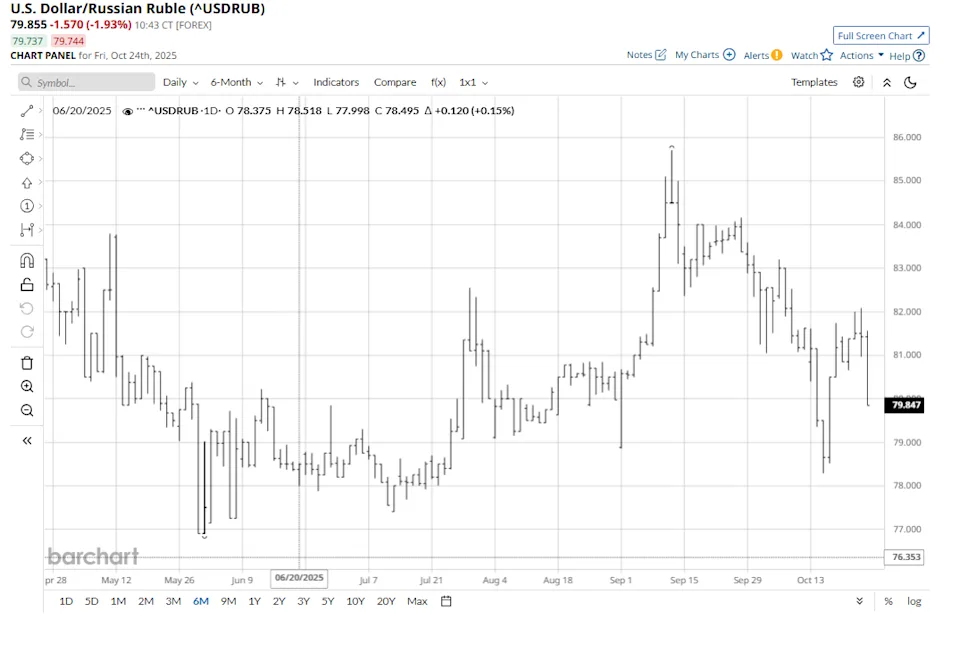
- The ruble surged nearly 40% against the dollar to its highest point this year — one of the strongest performances among major currencies. Although the rally has eased in recent weeks, the currency remains up about 28%, with one dollar now buying about 81 rubles — a significant drop from about 113 rubles at the start of the year.
Why has it outperformed expectations in 2025?
Forex markets are notoriously complex, with currencies rising or falling for very different — and often contradictory — reasons.
In 2025, however, there are some fairly clear explanations for the dollar’s decline against the Russian currency. A key factor has been the broad-based weakness of the dollar.
Earlier this year, the implementation of cumulative retaliatory tariffs undermined confidence in the economy and, by extension, in the U.S. currency.
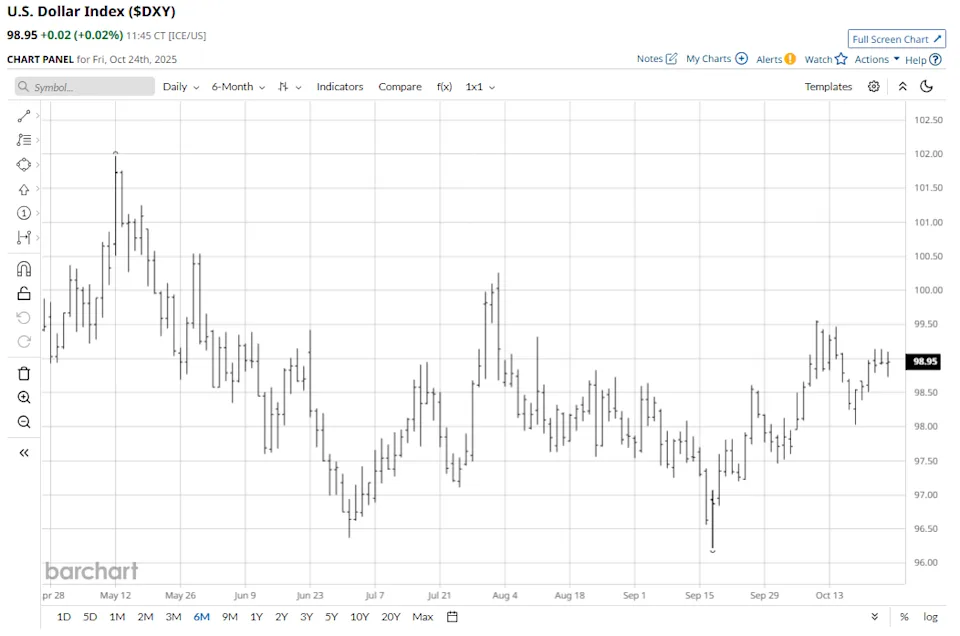
The U.S. Dollar Index ($DXY), which tracks the currency against a basket of major currencies, is down about 9% this year, a decline that helps explain the dollar’s relative underperformance.
Another major factor has been shifting expectations surrounding the war in Ukraine. Renewed hopes for a ceasefire have helped the ruble. Before Russia expanded its military operations in Ukraine in early 2022, the USD/RUB exchange rate was hovering around 70 to 80.
Russia’s invasion sent the pair above 129 rubles/dollar. By late October, the exchange rate had returned to the upper end of its pre-war range, reflecting a tentative recovery in investor confidence and hopes that the conflict may finally be entering its final phase.
The Russian economy has also proven more resilient than many expected under the onslaught of sanctions, expanding by 4.1% last year. This strength, along with tight capital controls and high domestic interest rates, has also helped support the currency.
Still, economic momentum has shown signs of fatigue: GDP is forecast to grow by only about 1% this year. And if the conflict continues or escalates, the ruble’s gains in 2025 could quickly be reversed.
What to watch?
In this context, the USD/RUB pair remains a useful barometer of the broader global economy and geopolitical risk sentiment.
While not one of the most traded currency pairs, its movements are often influenced by oil market fluctuations and shifting perceptions of geopolitical stability, making the pair worth watching in Q4 and beyond.
The ruble’s rise this year has highlighted two key themes: the impact of US trade policy on the dollar’s performance and the market’s cautious optimism about diplomatic progress in Eastern Europe.
Even for traders who are not actively trading USD/RUB, its direction can provide important signals, especially for positions in energy-linked currencies that tend to move in tandem with geopolitical and supply chain risk shifts for commodity markets.
For example, new sanctions on Russia could push the ruble lower and strengthen the dollar, while a credible peace deal could further strengthen the currency while causing new volatility in global currency markets.
A peace deal would also likely bring more Russian crude into the global energy market, potentially affecting energy prices and currencies like the Australian dollar and Canadian dollar.
At the end of the day, the strength of the ruble in 2025 is hard to ignore. The USD/RUB pair has emerged as one of the most interesting currency pairs of the year.
As the year draws to a close, traders will be watching closely to see if the dollar’s recent rally marks a real change in momentum or just another pause in the ruble’s remarkable run in 2025.
