Accounting rules are designed to enhance transparency and facilitate accurate financial valuation, but they can also mask an organisation’s true financial health. Today, a common accounting trick could be to cover up systemic risks in the US banking system by hiding the significant depreciation of commercial banks’ bond portfolios.
When a company buys bonds such as US Treasury bonds, it has the option to classify them as “held to maturity” (HTM). In principle, this signals the intention to hold such bonds until maturity. They are recorded on the balance sheet at their original cost. If the market price for the bonds increases or decreases, the unrealized losses or gains are not recorded in the income statements.
If the company wants to retain the option to sell the bonds before they mature, it is supposed to classify them as “available for sale” (AFS). These are recorded on the balance sheet at their current fair value, with unrealized gains and losses reflected in the income statement. This accounting trick allows banks to cover huge potential losses lurking on their balance sheets.
Let’s take a $100 bond as an example
- If the bond is available for sale (AFS), it would be recorded on the balance sheet in the first year as an asset of $100.
- If the market value of the bond were to decrease to $90 the following year, it would be recorded at that value on the balance sheet with a corresponding unrealized loss of $10 on the income statement for that year.
- But if the bond is designated HTM (held to maturity), it would remain a $100 asset on the balance sheet in the second year despite the decline in market value.
- The company is only required to include information about the change in fair market value in the footnotes to its financial statements, and there would be no entry on the company’s income statement for that year.
The Fed’s books would contain staggering unrealized losses. As Treasury bond prices fell and yields rose (bond prices are inversely related to yields) after the Federal Reserve raised interest rates to combat inflation, many banks used the HTM accounting option to cover the significant depreciation of their bond portfolios.
For example, the Fed recently reported $1 trillion in unrealized losses on its securities last year, up from $948.4 billion in accounting losses reported in 2023. For the banking system as a whole in the first quarter of 2025, it was $413 billion.
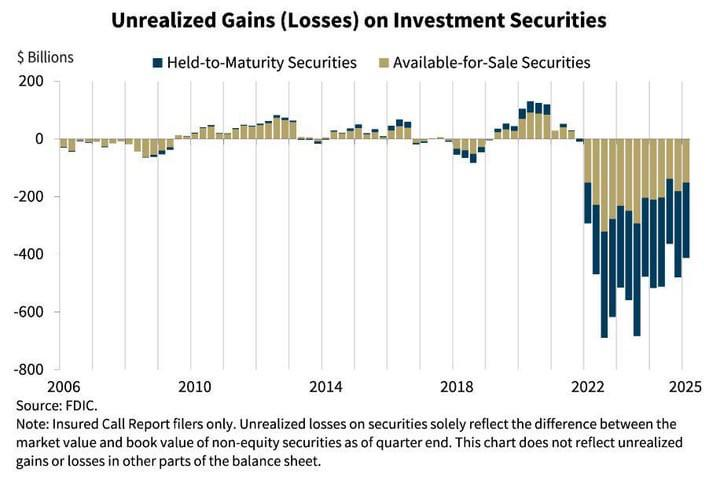
This has no practical effect on the central bank’s operations, because it will almost certainly hold its securities to maturity, meaning it will never incur these significant losses.
“These paper losses do not affect monetary policy operations and are not a significant issue given that the Fed holds its bonds to maturity.” However, many commercial banks are in the same position, and a decline in the values of their bonds could potentially affect their operations.
Accounting Tricks and the Failure of the Silicon Valley Bank
While a bank may initially have every intention of holding some bonds to maturity, it has no way of knowing whether it may need to liquidate some or all of its portfolio to cover unforeseen operating expenses. Companies are allowed to change the accounting designation from HTM to AFS to liquidate the securities.
In other words, unlike the Fed, commercial banks could potentially actually deal with their unrealized losses. Labeling bonds as “held to maturity” on their balance sheets masks this potentially significant systemic risk.
Turning unrealized losses into realized losses is exactly what happened at Silicon Valley Bank (SVB) in 2023.
Things began to unravel when Silicon Valley Bank sold a large portion of its bond portfolio to raise cash at a loss of $1.8 billion.
At the time, SVB CEO Greg Becke said the bank made the sale “because we expect continued higher interest rates, pressures in public and private markets, and increased levels of cash demand from our clients.”
The bank bought the bonds when interest rates were low. As a result, the bank’s $21 billion available-for-sale bond portfolio was not yielding any more than it was burning cash.
Meanwhile, rising interest rates caused the portfolio to decline significantly. The plan was to sell the lower-yielding, longer-term bonds and reinvest the money in higher-yielding, shorter-term bonds.
Instead, the sale hurt the bank’s balance sheet and caused anxious depositors to withdraw funds, which amounted to a good old-fashioned bank run.
Signature Bank and First Republic Bank failed for similar reasons. The US Federal Reserve was forced to create a bank bailout program in order to protect other banks from a similar fate.
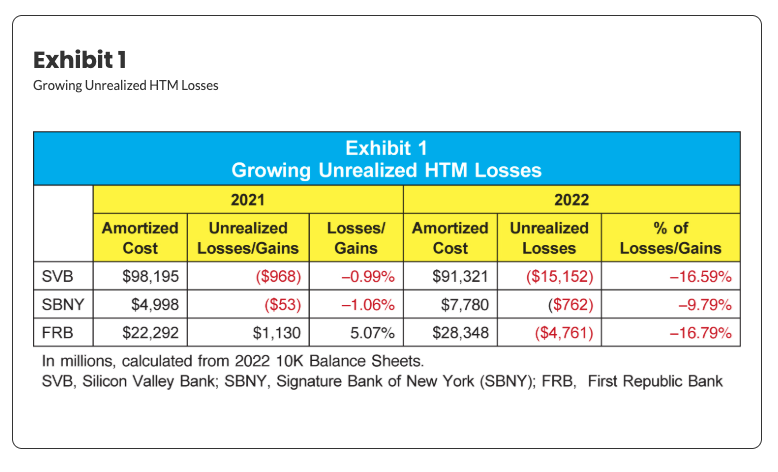
Before deciding to sell its undervalued bonds, SVB had significant unrealized losses on its HTM portfolio, as did Signature and First Republic. Had those unrealized losses been reported, observers might have realized the banks were in trouble sooner.
As the CPA Journal explained, “Considering the increases in unrealized losses from 2021 and 2022 in these cases…” The companies’ income statements would have had a material negative impact on expected earnings per share (EPS).
The CPA Journal went on to argue that “weaknesses” in the HTM accounting method “may, in retrospect, have obscured the risks these banks faced in today’s high-interest rate environment.”
The Problem Hasn’t Gone Away – What’s Happening Today?
Many banks are still saddled with significant unrealized losses. Whether they are accurately reflected in their financial statements remains a major question.
Unrealized losses are a ticking time bomb for U.S. commercial banks.
As of December 31, 2024, there were approximately $482 billion in unrealized losses in AFS and HTM bond portfolios. However, much of this is hidden on individual banks’ income statements because they have labeled their bonds as “held to maturity.”
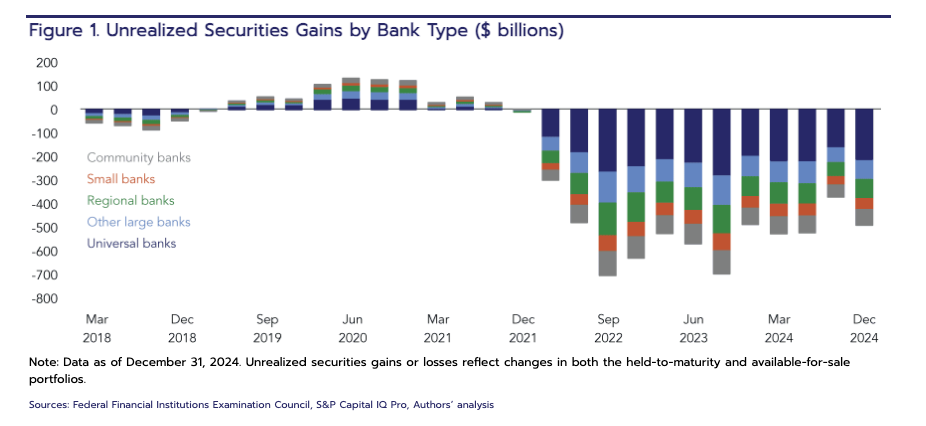
This is not a problem right now – until it is. If banks face any kind of sudden pressure, they could be forced to start liquidating these undervalued bonds, setting off a cascade of bank failures. And as we saw in 2023, a banking crisis can happen suddenly and unexpectedly.
All it takes is one… bad news
All it takes is one bad news story about any of these banks and we could have another banking crisis like the one we had in March 2023.
To put it bluntly, the HTM accounting loophole makes it easy to fabricate a window dressing and deceive the public.
This means that the U.S. banking system may be facing far greater systemic risk than the public realizes.
