The changing dynamics of global trade and the economy have intensified the search for a stable, universally accepted unit of account for international settlements. Recent geopolitical tensions, such as Russia’s exclusion from the SWIFT payment system, have accelerated efforts to find alternatives to the dollar. In response, the BRICS nations – which include Brazil, Russia, India, China and South Africa – are exploring the creation of a common currency tied partly to gold and partly to a basket of their own currencies. At the same time, China is increasing its gold reserves as part of its de-dollarization effort. This effort – using distributed ledger technology (It is a record of information or database that is shared across a network) as its basis – has already drawn sharp criticism. US President-elect Donald Trump has threatened 100% tariffs on BRICS nations if they seek to adopt a currency that challenges the dollar’s dominance. The BRICS bloc, however, holds undisputed economic power. Representing 40% of the world’s population, the BRICS contributed 31.5% of global gross domestic product in 2023, surpassing the G7’s performance (30.7%). However, their currencies remain underrepresented in global trade, with the dollar dominating 88% of foreign exchange transactions. However, intra-BRICS trade accounted for 37% of their total trade in 2022, a 56% increase from 2017. This growing trade volume underscores the bloc’s determination to strengthen its economic independence. 
A gold-backed digital currency could be the BRICS’ monetary revolution. Lower transaction costs and reduced exchange rate volatility are among the tangible benefits. If even 50% of intra-BRICS trade shifted to such a currency, savings in transaction costs of 1%-2% could translate into billions of dollars annually.
These savings could be reinvested to fuel economic growth and enhance the efficiency of financial transactions. DLT offers the transparency, security, and efficiency needed to support such a currency.
With the contribution of gold reserves, each digital unit would be backed by physical assets stored in secure vaults, with regular audits ensuring accountability.
Smart contracts could dynamically adjust exchange rates to reflect trade patterns and the economic conditions in which bilateral trade takes place. This would enable real-time settlements, reduce delays, and enhance trust between participants.
Such a system could even attract non-BRICS states seeking alternatives to dollar-dominated networks, potentially increasing the BRICS bloc’s share of global trade beyond its current 18%.
The acquisition of monetary gold
The foundation for realizing the vision is already in place. As of mid-2024, the World Gold Council estimates that the BRICS nations collectively hold 6,200 metric tons of gold, representing 15.5% of global reserves.
Over the past two decades, these reserves have increased by about 150%, reflecting a deliberate effort to reduce dependence on the dollar and enhance financial stability. However, the balance of gold holdings remains heavily tilted in favor of the G7 countries, which collectively hold 17,500 tons, or 47.7% of global reserves. 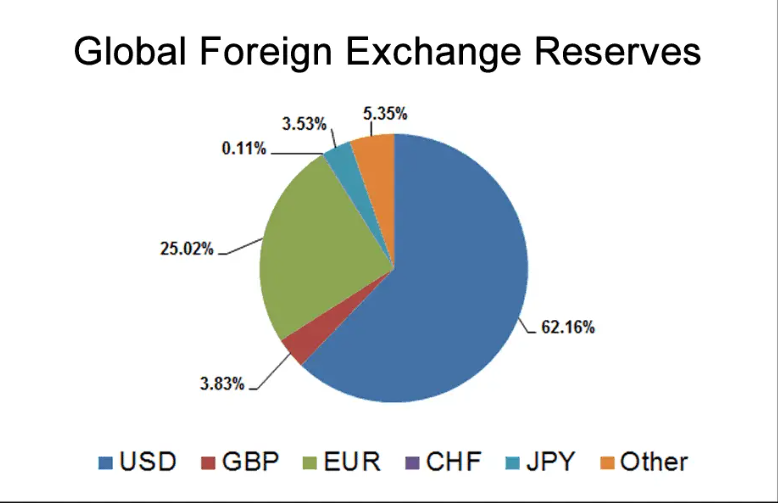
Some potential benefits of a gold-backed digital currency are clear, but implementation will not be straightforward.
Significant coordination among BRICS countries is required, along with investments in technological infrastructure that will transform the global financial system. Geopolitical obstacles, including potential sanctions or tariffs, add further complexity to the endeavor.
However, with their strategic gold reserves and economic clout, the BRICS group is likely to continue to advance ideas for reshaping global trade and providing an alternative to the existing dollar-centric order.
What’s behind China’s gold rush?
After a six-month hiatus from an 18-month gold-buying rally, the People’s Bank of China (PBOC) returned to its policy of large gold purchases in November. On October 31, gold hit a record high of $2,790.15 an ounce.
While it fell 5% last month, it remains about 28% higher year-to-date. While the value of the PBOC’s gold holdings fluctuates with market prices, China’s central bank appears to be more concerned with acquiring more gold than with changing valuations.
By the end of August this year, the PBOC’s gold reserves had reached 2,165 tonnes, or about 4% of its total foreign exchange reserves. It’s no surprise that in 2023, China led the world’s financial institutions in gold purchases, and it could do the same in 2025.
Domestic Demand: Part of China’s Gold Rush
There are many explanations for Beijing’s bold policy on gold reserves. To be sure, gold has long been a “safe haven” for investors, especially during times of economic uncertainty. Currently, several economic factors are projecting uncertainty globally, including China, which is driving demand.
The ongoing collapse of the real estate sector, a shaky stock market, lower consumer spending, missed GDP growth targets, and a falling yuan are just a few of the problems. In addition, there are few opportunities for Chinese to invest domestically, and capital controls make it difficult for most Chinese to take advantage of overseas opportunities.
Given gold’s history as a reliable store of value, it is attractive to all levels of investors, leading to an increase in domestic demand. For all these reasons, the PBOC is looking to meet the Chinese public’s demand for gold.
Rising global uncertainty
But Beijing’s strategy to promote gold involves more than just meeting domestic demand.
The conflicts in Ukraine and the Middle East, including the evolving situation in Syria, have led to a much less predictable international order. Today, the world is leaning more towards uncertainty than predictability, which usually leads to an increase in demand for gold. This has undoubtedly been a factor in driving gold prices higher, but it has not had much of an impact on China’s acquisition plans, which have been implemented for the past several years.
The Monetary Strategy
Beyond global instability, the strategic goal behind Beijing’s gold policy is, at the very least, to reduce its dependence on the dollar. This would include shielding it as much as possible from the punitive measures—such as trade sanctions, export restrictions, and tariffs—that Washington often imposes on its economic or geopolitical rivals.
Both China and Russia are subject to and are subject to sanctions and tariffs by the United States.
Although the US dollar’s prominence in the world has declined in recent years, 64% of global debt, 54% of global trade, and about 59% of global foreign exchange reserves are denominated in dollars—the closest competitor is the euro, at 20%.
The Chinese Communist Party (CCP) is right to assume that more punitive economic policies from Washington will negatively affect China.
These concerns have become especially acute with President-elect Donald Trump returning to the White House in January 2025.
Donald Trump has pledged to raise tariffs on Chinese goods and services and even add sanctions based on China’s behavior on trade and other factors.

Is the yuan pegged to gold to compete with the dollar?
However, Trump is not the main player in Beijing’s gold-buying policy. The CCP’s long-term strategy is to challenge US hegemony. To do that, it needs to replace the dollar with the yuan, regardless of who is in the White House.
China’s gold purchases play a major role in this ambitious plan. The thinking is that the yuan pegged to gold would eventually make it more tradable than it is today.
This is precisely why Beijing has been steadily replacing US dollar bonds with gold well before the 2024 election cycle. Shrinking China’s US bond portfolio is the other half of Beijing’s dollar-replacement strategy.
Selling large amounts of bonds can reduce market demand and encourage other countries to do the same. In early 2022, China’s US Treasury bond portfolio exceeded $1 trillion. By May 2024, it had fallen to $768.30 billion.
This trend is likely to continue. At some point, China hopes to be able to prop up the value of the yuan to at least compete with the dollar on the world stage. The currency war is expected to prove relentless with incalculable (financial) casualties.
The best-known type of distributed ledger is the blockchain, so named because it stores individual transactions in groups, or blocks, linked together in chronological order to form a chain.
