Big Tech’s €37.5 billion shifts market conditions
A record €2 trillion was reached on Thursday, November 19. Since the beginning of the year, corporate borrowing in the European market has increased by approximately €49 billion compared to 2025. Of this increase, roughly €37.5 billion comes from so-called “hyperscalers”—the tech conglomerates that develop massive cloud computing and artificial intelligence infrastructure. In other words, more than 75% of the additional corporate borrowing is linked to these tech giants. Alphabet, Amazon, and Meta rank among the four largest non-financial issuers of bonds denominated in European currencies for 2026. Their pivot toward Europe is no coincidence. Investments in data centers, processors, computing systems, and energy infrastructure require capital on an unprecedented scale. American companies, too, are seeking to diversify their sources of funding by tapping into international bond markets. As Trust Economics points out, the bulk of the increase in borrowing by non-financial corporations stems from American firms seeking financing in various markets. Consequently, Europe is not merely funding its own requirements; it is increasingly participating in the financing of the investment strategies of major American corporations.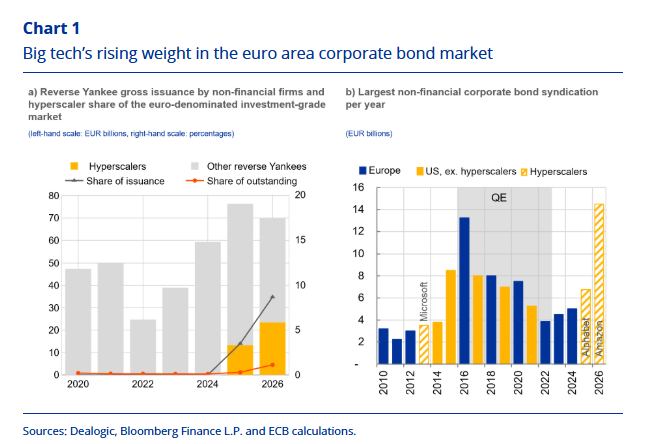
The ECB’s Warning: Risk of Crowding Out Other Borrowers
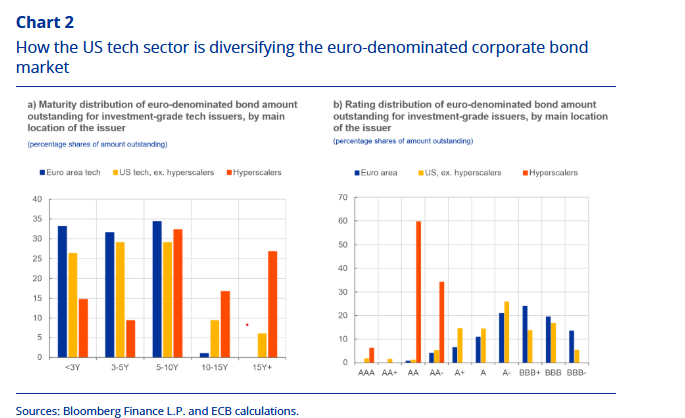
This development has not gone unnoticed by the European Central Bank. In an analysis from August 2026, the ECB examined the implications of the growing presence of American tech giants in the Eurozone corporate bond market. “Hyperscalers” already had approximately €40 billion in bonds outstanding within the Eurozone market, accounting for nearly 10% of new corporate debt issuances denominated in euros by non-financial firms. The concern centers on increasing risk concentration, the exposure of European portfolios to the U.S. economy, and the possibility that massive bond issuances by Big Tech firms could directly compete with other businesses for investment capital. The issue is not merely that these tech giants are borrowing more; it is that the persistent supply of such large-scale issuances could shift the balance of the market. When many major issuers vie for the same pool of capital simultaneously, investors gain greater bargaining power and demand higher yields. This could translate into more expensive financing for other borrowers as well. The ECB has also pointed out that the growing presence of US technology companies may increase the exposure of European investors to a sector that is particularly vulnerable to any potential shift in expectations surrounding artificial intelligence.From artificial intelligence to costlier sovereign debt
Herein lies the greatest contradiction. Eurozone governments need to borrow more, precisely at a time when US technology giants are claiming an ever-larger share of available investment liquidity. Sovereign debt issuances—along with those from supranational organizations and state-guaranteed entities—account for approximately 40% of the European syndicated bond market. These financing requirements are expected to rise further by 2027. Germany is projected to become the largest sovereign debt issuer in the Eurozone, while total gross sovereign bond issuance across the region could exceed €1.5 trillion, according to estimates by Trust Economics. In France, fiscal uncertainty and political developments ahead of the 2027 presidential elections introduce an additional risk factor. The problem is that states cannot indefinitely postpone their financing needs. They must cover deficits, refinance maturing debt, and fund new strategic expenditures. If an increased supply of corporate bonds from Big Tech puts pressure on market yields and risk premiums, governments could face even less favorable borrowing terms. This does not imply an automatic or inevitable spillover from corporate borrowing to sovereign debt. It is, however, a real mechanism for the transmission of pressure—one that becomes increasingly significant as the financing requirements of all issuers grow.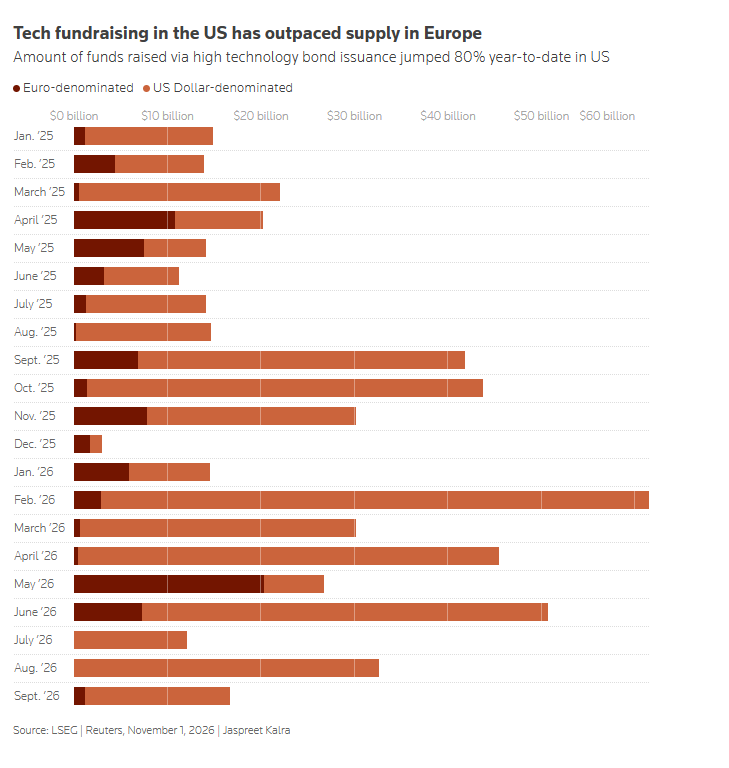
Markets begin to demand a higher price
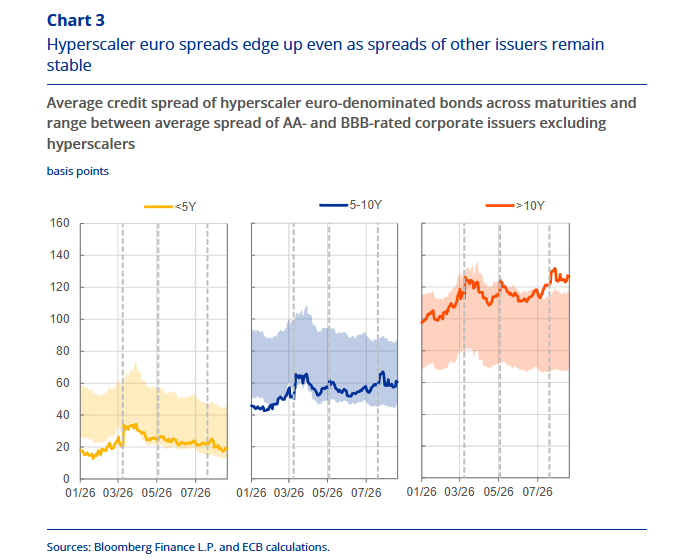
The first signs of strain have already emerged. Despite relatively strong demand for corporate bonds, investors are becoming more selective regarding large-scale issuances by “hyperscalers.” Tech groups are being forced to offer higher risk premiums to attract buyers, while in the secondary market, their bonds are trading at yield levels typically associated with companies that have lower credit ratings. This sends an important signal to the market: even the most powerful tech giants can no longer take access to cheap financing for granted. And there is another risk. If expectations regarding the profitability of artificial intelligence prove overly optimistic, the massive investments in infrastructure may fail to deliver the anticipated returns. In that scenario, the problem would not be limited to the cost of servicing the companies’ own debt; it would also affect the investors who have financed this expansion through European markets.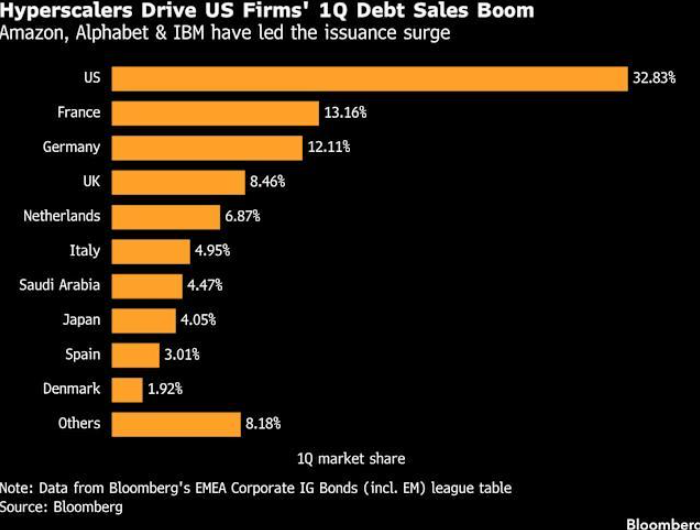
2027 Promises to Be a Difficult Year for Government Budgets
The aggressive increase in borrowing by Big Tech coincides with a period in which governments are required to refinance existing obligations at significantly higher costs. The previous wave of borrowing took place in an environment of exceptionally low interest rates. Refinancing these obligations is now occurring under less favorable terms. Across OECD countries, debt-servicing costs already consume an average of 3.3% of GDP—a figure expected to rise further. At the same time, fiscal deficits remain high, limiting the room for maneuver available to governments should a new period of economic turbulence arise. An increasing reliance on short-term borrowing may temporarily contain costs, but it creates greater exposure to future interest rate fluctuations. While a new sovereign debt crisis is not the baseline scenario, the accumulation of risks makes 2027 a year of heightened fiscal and financial uncertainty. Europe is financing the technological revolution—but who is footing the bill? The €2 trillion record reveals a deeper contradiction within the European economy. The Eurozone is being called upon to simultaneously finance its own sovereign needs, its energy and defense infrastructure, corporate investments, and a significant portion of the technological expansion of American conglomerates. “Big Tech” is leveraging the European market to secure capital on a scale that, until recently, was unusual for European corporate debt markets. European investors are taking on increasing exposure to the American tech economy, while European governments must continue to borrow to meet their own obligations. The major pitfall is that all these demands converge on the same market, at a time when capital has become more expensive and fiscal risks have intensified. Europe thus risks sinking deeper into a debt trap—not only due to its own deficits, but also because of a global investment race in which it is effectively financing key players based on the other side of the Atlantic. The critical question for 2027 is who will have priority access to European funds, and who will be forced to pay more to secure them. For as Big Tech ramps up its borrowing and governments increase their debt issuance, the pressure on the same pool of capital continues to mount. And in this battle, the ultimate cost could extend far beyond Silicon Valley—reaching the national budgets and taxpayers of the Eurozone.*The photo is develop with the use of AI
Please follow and like us:
