The dollar has long enjoyed its status as the world’s top reserve currency, although President Donald Trump’s recent trade policies have sparked debate about its future dominance. At the same time, gold’s rally is shaping the emerging monetary order that will emerge after the great instability.
The strength of the dollar and its associated role as the world’s top reserve currency offer significant benefits to the United States. High demand lowers the cost of borrowing for the U.S. government, ensures that the country can run larger trade deficits without facing a balance of payments crisis, and gives the United States significant influence over international financial systems and economic policies.
Dedollarization – countries reducing their reliance on the dollar as a reserve currency and as the primary unit for international financial transactions – could lead to increased interest rates and higher borrowing costs for the government, while also affecting America’s international financial leverage.
The plan to dedollarize
Fears of a deepening trend toward dedollarization have been heightened in recent days by the U.S. government’s tariff plans, which many warn threaten the currency’s continued strength and historic standing.
A group of academics has warned that “clumsy, erratic attempts to weaponize Washington’s economic advantages in geopolitical games pose the greatest threat yet to the dollar’s status as a reserve currency.” They noted that the dollar’s continued dominance is based on its liquidity, its role as the most common “unit of account” for global tradable goods, and ultimately its acceptance worldwide as a “trusted store of value.”
The above factors, they argued, had been jeopardized by the government’s tariff policies, citing as evidence the declining value of the dollar relative to other currencies.

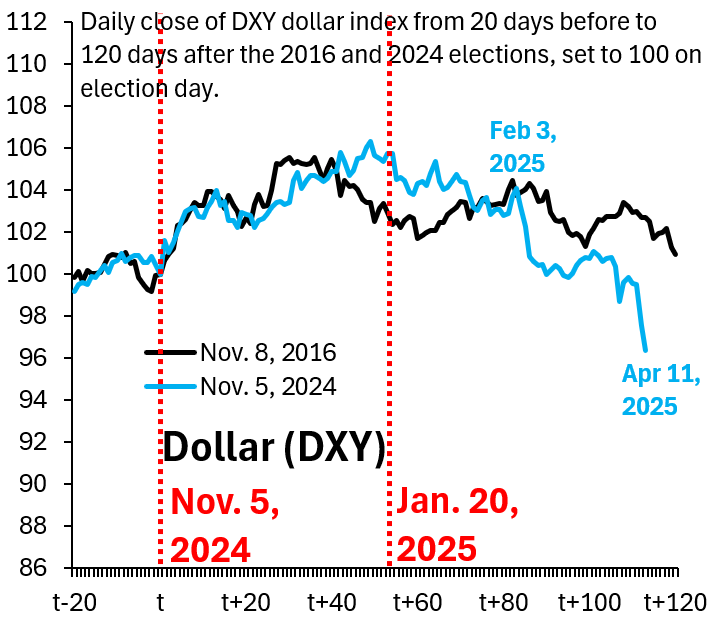
The dollar fell against most major currencies as markets reacted to the implementation of the reciprocal tariffs on Wednesday, April 2. The US dollar index fell below 102 twice on Wednesday, April 9, hitting its lowest levels since the presidential election.
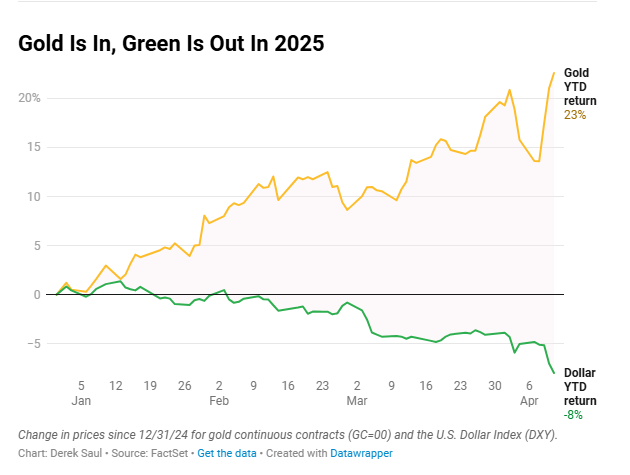
The dollar has fallen nearly 6% since the beginning of the year, with Thursday’s 1.7% drop (April 10) marking the biggest daily decline since November 2022.
This loss of confidence could weaken the dollar’s position as the global reserve currency.

What would dedollarization mean for the US?
Losing its position as the preferred currency in the world’s foreign exchange reserves, which it has held since the Bretton Woods Conference in 1944, would result in higher interest rates in the US, while also weakening the impact of “effective economic sanctions against foreign adversaries.”
However, many are not convinced that the administration’s trade policies or their negative effects on the US economy could overturn the dollar’s dominance.
A widespread move away from the dollar is also hampered by the lack of a suitable alternative. Tariffs could lead to increased volatility in currencies used worldwide. Regardless of what happens to the dollar, there appears to be no natural successor that could become the new dominant currency worldwide.
Vice President J.D. Vance, in March 2023, said that the dollar’s position as the world’s reserve currency undoubtedly represented “a huge boost to American consumers but a huge tax on American producers. “I know the strong dollar is kind of a sacred cow in the Washington Consensus, but when I look at the American economy and see massive consumption for useless industrial imports most of the time, I wonder if the reserve currency status also presents some disadvantages.”
We will say that tariffs cannot accelerate the trend towards de-dollarization. Half of the dollars printed are in circulation in the US – the other half are around the world to offset inflation.”
President Trump in late January warned members of the BRICS group that any attempt to replace the US dollar would result in economic retaliation. “We will demand a commitment from these seemingly hostile countries that they will not create a new BRICS currency, nor will they support any other currency that will replace the all-powerful US dollar or face 100% tariffs,” Trump said in a post on Truth Social.
The dollar is unlikely to lose its position anytime soon. If the US were serious about a long-term strategy of economic nationalism and isolationism, then that could change over time, but we think we are a long way from that point.
Historian and journalist Tim Stanley, speaking on British radio station LBC, said: “[Donald Trump] wants to crush the dollar. America has been in the historically awkward position that because it is the currency of choice, people buy dollars and store dollars. So people sell goods to America rather than buying things from America so they can bring dollars into their country. If the dollar is weaker, people buy more things from America because they are cheaper.
The Monetary Existential Conflict
Meanwhile, at the top of the monetary food chain, gold functions as an intergovernmental currency – and more importantly, as a currency of war. Paper monetary promises do not hold up to existential conflict. In times of rising geopolitical tension, governments need more gold in their treasuries.
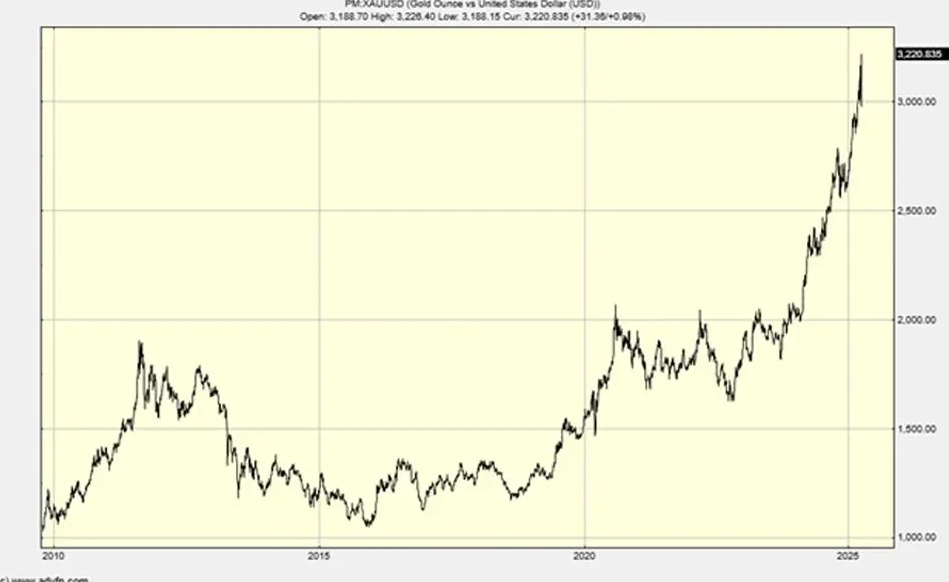
In its simplest form, gold is a strategic necessity. Here we are, with global tensions rising. And so, gold has followed a sharp upward trajectory. Gold hit a new all-time high of over $3,200 an ounce on Friday, April 11.
The precious metal jumped 1.4% in Asian trading on Friday (April 11), hitting $3,219.48, surpassing its previous high set just on Thursday (April 10), when it closed up more than 3% for the second straight day. Gold’s more than 20% rise since the start of the year is not only due to geopolitical tensions and the ongoing trade war, but also to massive gold buying by central banks, as well as expectations of further monetary easing from the Federal Reserve.
The latest US inflation data showed a significant slowdown in March, leading markets to discount three interest rate cuts by 2025, with a fourth likely.
Lower interest rates are helping gold, which offers no yield but becomes more attractive when the opportunity cost of investing falls, meaning it increases risk. At 9:51 a.m. Singapore time, gold was at $3,212.41, up 1.1% and on track for a weekly gain of nearly 6%. The Bloomberg Dollar Index fell for a fourth straight day.
- Tensions will rise dramatically—even from today’s levels.
- Just listen to the US government. What are they saying? They are openly preparing for a confrontation with China.
- That alone is deeply concerning.
- China is hoarding gold. No surprise there.
- Poland bought 29+ tons in February alone.
- Turkey, the Czech Republic, and India are buying similar amounts.
So, while many will talk about dedollarization, a Treasury collapse, persistent inflation – all the usual tropes – these are not necessary for gold to rise. But if any of these do come into play, the rise in gold prices could be monumental. Now, let’s look at the downside. And what is that?
For gold to really fall, there would have to be global calm. This seems like a low-probability scenario. However, let’s look at the downside. And it is…? Some might ask: What just happened?

All markets are interconnected by long-term arbitrage: This is the simultaneous buying and selling of the same (or similar) investment in two different markets at two different prices, a strategy that can lead to profits without taking on risk. When liquidity rushes to the exit, arbitrage relationships move valuations violently.
The ongoing tariff fall has triggered many such transactions, and now capital is being reallocated – some of it clearly flowing into gold.
Maybe something bad will come this way. But gold doesn’t need a major catastrophe to rise. In fact, the opposite is true: it’s the long-term rise in global tension that’s fueling the rise of said safe haven.
And for that reason, there’s no turning back. And yes, we hold gold — very little. But no, we’re not long-term gold fans. We’d rather make money in stocks in a calm, stable world. Unfortunately, that option doesn’t seem to be on the table right now — and here’s how a new monetary order is taking shape.
