US economic data show fiscal derailment as debt servicing costs rise, which will cast doubt on US geopolitical commitments to Ukraine and Israel, but also set the stage for tax hikes and deflation pressure on stock prices.
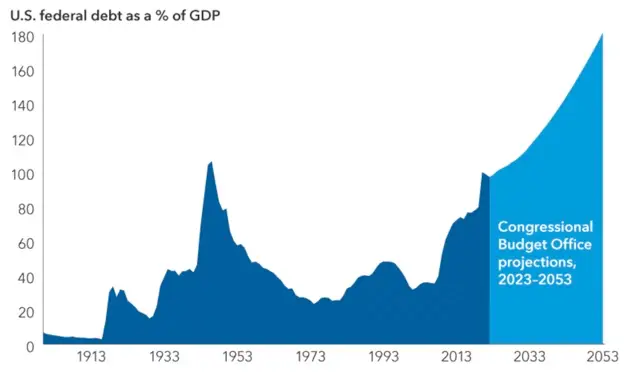
This highlights that in 2024 the focus will not be on the question of rising interest rates – as the markets are at gunpoint – but the issue of debt. The US debt “mountain” is growing rapidly – and the government could soon be spending more on interest payments than on defense. Over the next five years, net interest payments on the debt are expected to exceed defense spending.
More specifically, if the world’s largest economy’s debt mountain grows at the rate expected by the Congressional Budget Office, the government’s spending on net interest payments could rise from under $500 billion to a staggering 1.4 trillion dollars by 2033.
And a cursory glance shows that the limits of policy management of fiscal dislocation in the world’s largest economy have narrowed despite the fact that the election cycle will force the Federal Reserve to engage in supposedly procyclical policy to salvage whatever of its hitherto ineffective economic policies Joe Biden administration.
Defense spending
The fact that interest payments could soon outpace defense spending could be a source of concern for policymakers, with President Joe Biden vowing to ask Congress for more than $100 billion in funding to support both Israel as well as Ukraine.
The federal government’s debt has emerged as a major concern on Wall Street this year — even as everyone takes comfort in the narrative that an equally aggressive expansionary monetary policy will take place — with senators reaching a last-minute deal to raise the government’s borrowing limit. in May and Treasuries to face one of the worst sell-offs in the history of the US debt market.
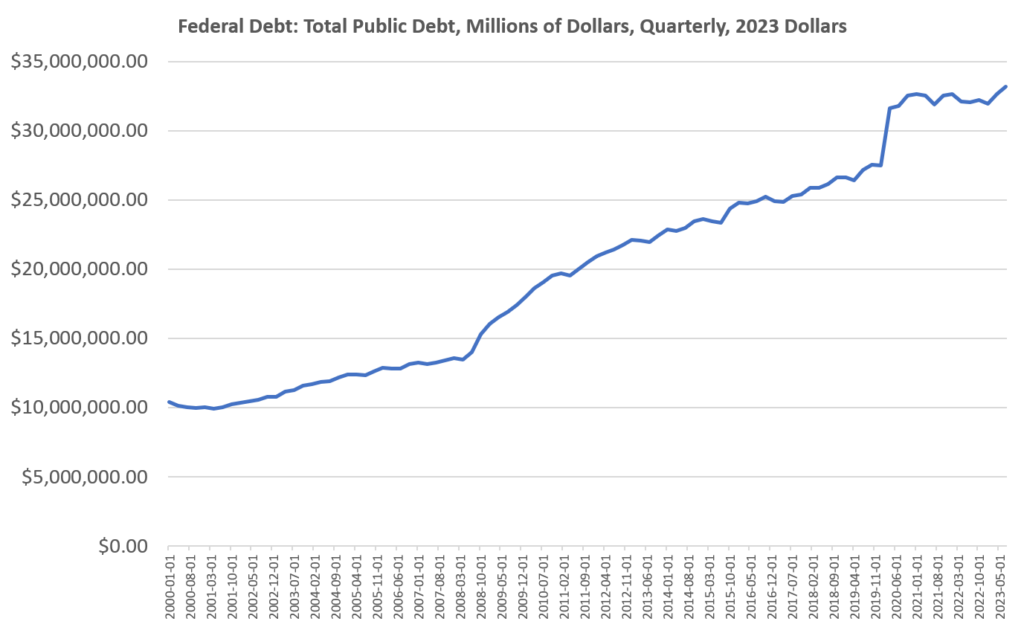
Liabilities of the US central government impressively exceeded $33 trillion on September 18 — a month later, the number had jumped by $33.64 trillion, indicating an average daily increase of $20 billion. US public debt indicates that the situation is approaching levels that could cause an economic collapse.
Typically, debt levels become a problem if “interest rates were higher than the rate of economic growth, the additional revenue generated by the economy each year became less than the interest payments on the debt, and the debt began to grow on its own.
The growing amount of debt could force the government to raise taxes, fuel further bond issuance and force the Federal Reserve to “lock” interest rates higher.
These decisions could cause slower economic growth, since government spending would necessarily have to be redirected to servicing the debt.
For investors, this could lead to lower stock market returns over time, given the strong long-term correlation between GDP growth and market returns.
The federal budget deficit is getting bigger and spiraling out of control
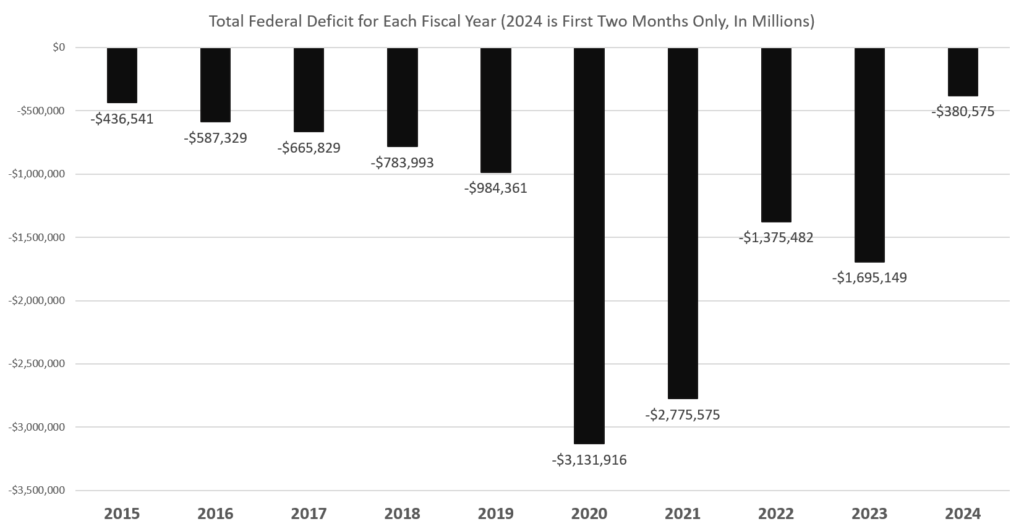
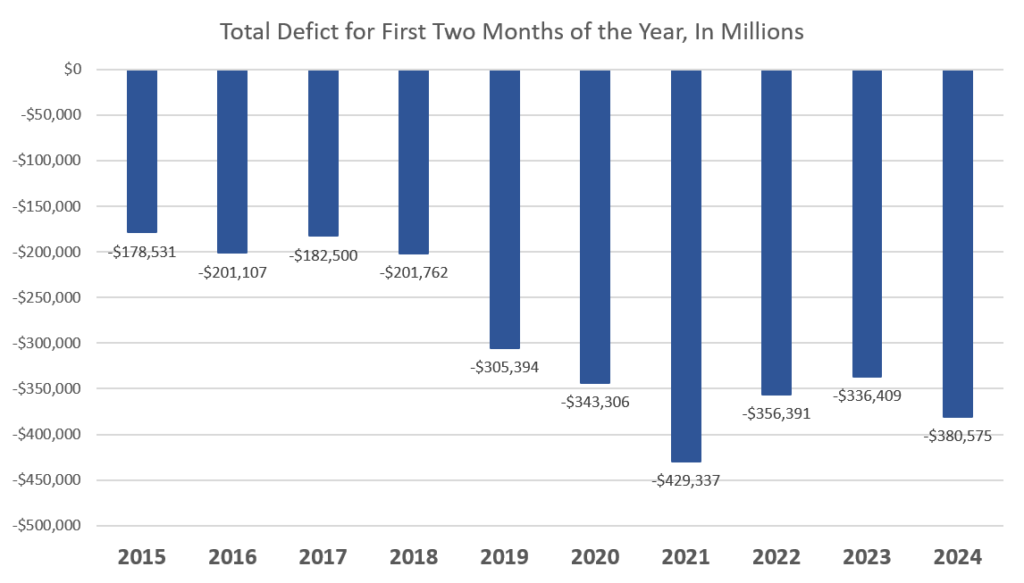
According to the Treasury Department’s latest monthly release, the overall fiscal deficit for fiscal year 2024 (which began on October 1) has already grown to more than $380 billion.
The new data, covering the months of October and November, put the U.S. economy on track for a total annual deficit of more than $2 trillion by the end of the current fiscal year. This would be an increase of more than 25% over the 2023 fiscal year, which saw a 23% increase over 2022.
A $2 trillion annual deficit in 2024 would make the 2023 deficit the third-largest on record, behind only the 2020-21 period when spending on Covid-related welfare benefits was seemingly unlimited.
Comparing the same two-month period in the previous decade, the data also suggest that deficit spending in 2024 will be second only to the Covid years in 2020 and 2021. In the first two months of fiscal year 2021, the deficit stood at more than 429 billion dollars.
The end of the era of zero interest rates
The US will add more than $7 trillion to its debt starting in 2020. To put this in perspective, we can note that total revenue for the US in fiscal year 2023 was $4.4 trillion. (Total federal government debt in 2023 exceeded 38% of all federal revenue.)
Many Americans have become numb to the amount of debt because they have been enjoying free money for too long. From the early 2000s to 2022, real interest rates were essentially zero (or even negative), meaning the federal government could borrow money at low interest rates.
Since interest rates were on a steady downward trend during that period, maturing debt could always be paid off with new debt that would incur even lower interest rates. This, however, ended in 2022.
What will disrupt the bond market?
Since then, if we look at the data in detail the interest paid on the new federal debt has increased significantly and the total amount of interest paid on the debt each year has doubled from 2019 to 2024.
For example, the yield on the 10-year note rose in 2022 and most of 2023, reaching nearly 5% in October 2023. On the other hand, for most of the decade from 2012 to 2022, the 10-year yield was between 2% and 3%. The 10-year yield has fallen since October, falling below 4%. But that still makes it more than double what has been considered “normal” for most of the last decade.
This situation has amplified the real cost of the rising national debt. As of 2019, the total national debt has increased by 25%, but interest paid on the debt has increased by 75%. More specifically, interest on the debt amounted to nearly $573 billion in 2019, but will exceed $1 trillion in 2024. This rate of growth has far outstripped every other major category of spending except “social income security” (the so-called social transfers) which includes many of the trillions in Covid-related spending of recent years.
In contrast, Social Security increased 40% and Medicare increased 30%.
Ιn the background cuts in public spending
If the current trend in interest and debt continues, Congress will have to make some very unpopular spending decisions. As mentioned above, interest payments now make up a larger portion of federal spending than military spending and Medicare.
If the debt continues to grow at its current rate, debt service requirements will “eat up” more and more of the federal budget, requiring cuts in other areas of the budget to ensure bondholders are paid. It’s easy to imagine that about a fifth of the budget will go to paying off bonds in the not-too-distant future.
This means that for every $100 in taxes that the US government extracts from the taxpayer – mainly through income and payroll taxes – 20% of that will go to pay interest that produces no benefit for ordinary citizens.
Interest payments are simply payments on old debts—for lost wars, failing schools, retired government employees.
The intervention of the FED
Of course, there is the threat of a spiraling debt spiral as the central bank prints dollars in an attempt to pay down debts while avoiding the fiscal austerity needed to avert disaster – and salvaging a flimsy and irrational economic policy. The only possible overlap here is that as it becomes more obvious that interest payments are wiping out today’s wage earners, it will make more political sense to simply repudiate the debt.
The idea that the government has some sort of moral obligation to pay its debts has always been nonsense. Interest payments have always been paid for by taxation, and are therefore nothing more than a forced transfer of wealth from taxpayers to bondholders. However, bondholders voluntarily assumed the risk of holding US debt.
So, if the US goes bankrupt, that is harsh fate and a risk that investors have willingly taken on – they should be aware of the concept of moral hazard. Taxpayers, on the other hand, are the unwitting party to the deal.
The moral solution in this case is to relieve the taxpayers of the obligation imposed on them by the elite and successive governments. For this basic political reason, the US will have to declare a default at some point in the future – a scenario that should no longer be considered improbable.
