At the World Economic Forum in Davos, President Donald Trump said out loud what normally goes unsaid, and in doing so, revealed a deep and dangerous vulnerability that the entire system has been trying to hide. Specifically, in an interview with Fox Business’s Maria Bartiromo, when asked about the possibility that European countries might respond to his now-repeated threats of tariffs by selling their vast holdings of American assets, President Trump made a striking and unprecedented threat: “If they do, they do. But you know, if that happens, there will be a big payback on our part. And we have all the cards.”
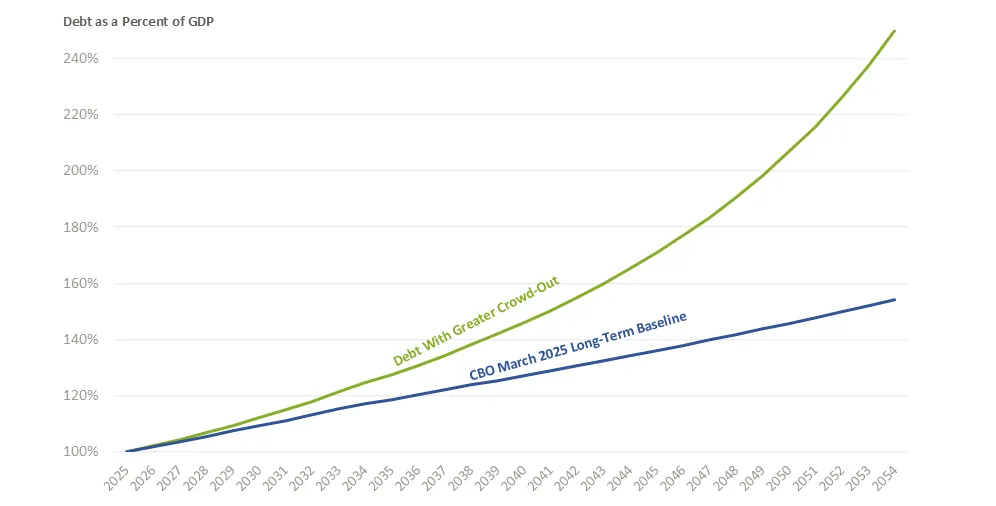
US debt is out of control
Extreme Fragility of the U.S. Financial System
The President of the United States, on the international stage, is openly threatening America’s closest allies not to sell the U.S. government’s own debt. This is not the language of a confident creditor who “holds all the cards.”
This sounds like the language of a desperate debtor, trembling at the thought of what will happen when his largest creditors head for the exit. President Trump’s threat is not an act of strength; it is a profound admission of weakness. It is a public acknowledgment that the U.S. Treasury market, the bedrock of the global financial system, is in a state of extreme fragility.
And it is the loudest warning bell yet that a sovereign debt crisis is no longer a distant possibility but an imminent and inevitable reality. You have to understand that when the President of the United States publicly threatens America’s closest allies not to sell US government debt, he is not speaking from a position of strength; he is exposing a deep and frightening weakness at the heart of the global financial system.
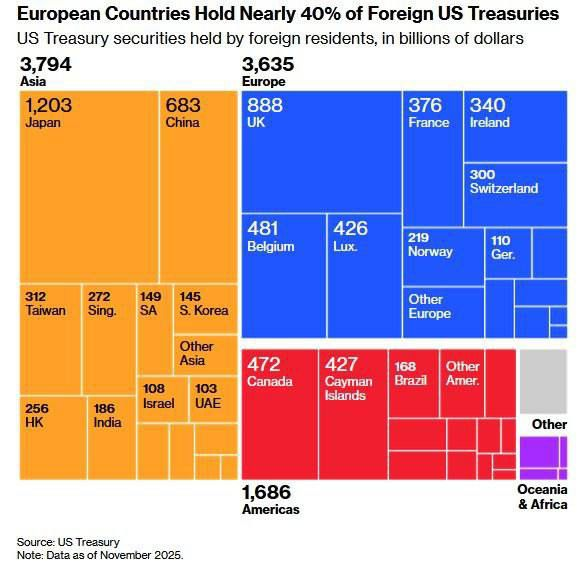
Note that China has reduced its holdings of US Treasuries from $1.3 trillion to just $682.6 billion (a 17-year low), that Japan is facing a bond market crisis that will force it to sell some of its $1.2 trillion in Treasuries, and that Russia has pulled out for good, having had its reserves seized – it appears that the traditional base of buyers of US debt has collapsed.
You have to understand that Europe is the last remaining major buyer, accounting for 80% of all foreign purchases of US Treasuries from April to November 2025, and that Trump’s threat is a desperate attempt to prevent them from heading for the exit.
Pension funds are pulling out of Europe
Large Nordic pension funds – among the world’s largest and most conservative investors – are already selling their US bonds, citing rising geopolitical risk and concerns about unsustainable US debt, and that this is just the beginning of a broader European exodus.
The United States must issue $11-12 trillion in new debt by 2026 to refinance maturing bonds and cover its deficit, and that, with traditional buyers gone, the Federal Reserve will be mathematically forced to monetize this debt through massive money printing.
When the Fed is forced to launch a new wave of quantitative easing to absorb debt that no one else wants, it will likely trigger a massive flight of capital from the $100 trillion global bond market to the tiny $2–3 trillion precious metals market, creating an avalanche of biblical proportions.
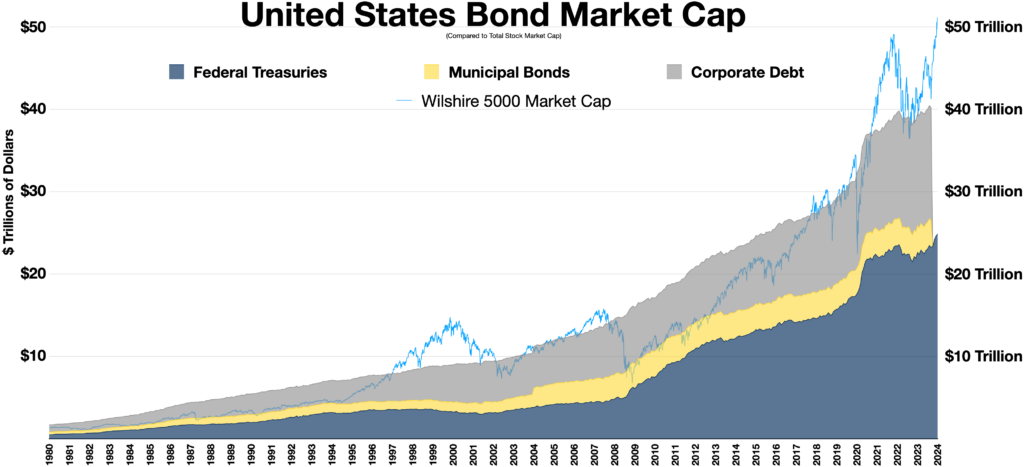
The total bond market is $150 trillion (government and corporate bonds) – The $100 trillion we are talking about includes investment grade bonds based on the fund charter and subtracts about $52 trillion that is held within the US.
Market Size
Assessment
Global Bond Market
around $140-$150 trillion
USA (Significant Part Monopoly)
around $51,6 trillion (around 40% of total)
China
around $20-$24 trillion
Global Bond Market
And now the question is: “Does President Trump’s Davos threat to Europe reveal that the U.S. Treasury market is in crisis?”
Let’s dig deeper:
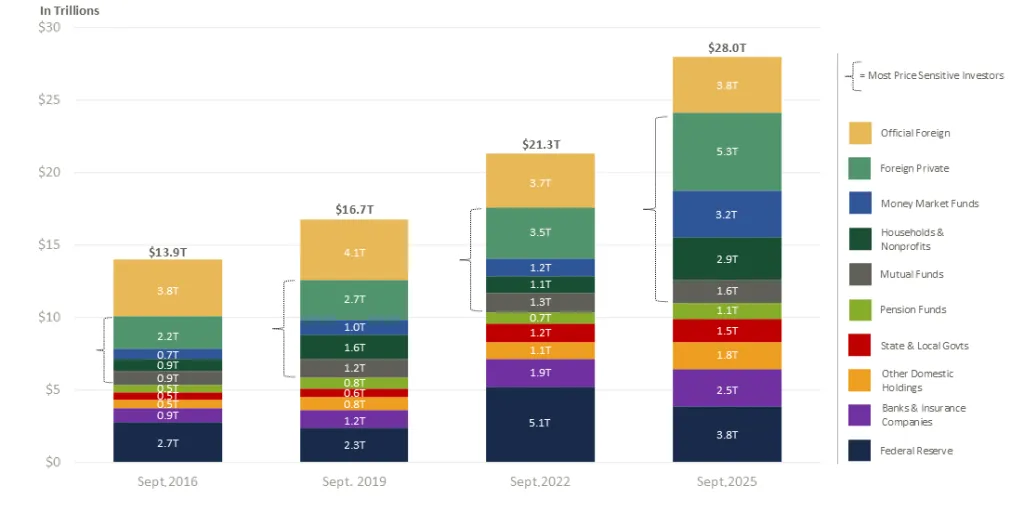
It is becoming increasingly clear that the buyer base for U.S. Treasuries is collapsing. For decades, the United States was able to run huge deficits and finance its government through reckless issuance of government bonds because it always had a reliable and “captive” group of foreign buyers.
These buyers – mainly major exporters like Japan and China, as well as oil-producing states in the Middle East – needed a safe and liquid place to “park” the trillions of dollars they were accumulating through trade.
They were recycling their trade surpluses back into US bonds, creating a symbiotic relationship that allowed the US to live beyond its means and the rest of the world to have a stable reserve asset.
Because that era is now over and the traditional buyer base of US debt has collapsed.
As the cracks appear, Nordic pension funds are leading the exodus. As if President Trump’s public threat to confirm the crisis wasn’t enough, the European flight from US assets is already underway.
Accordingly, large pension funds in Sweden, Denmark and Finland are actively reviewing their exposure to US assets, citing geopolitical tensions, rising debt and policy uncertainty. And this is crucial: these are not speculative hedge funds; these are the largest, most conservative, long-term investors in the world – and they are all worried.
The structure of the US debt
Investors around the world can’t get past America’s $12 trillion debt problem. The collapse of the foreign buyer base is coming at the worst possible time for the United States. The US government faces an unprecedented funding crisis in 2026.
It needs to refinance about $9 trillion in maturing debt, while running a budget deficit that is projected to range between $2–3 trillion. That means the US Treasury will have to issue an astronomical $11–12 trillion in new debt in a single year – and the world knows it.
Because this is not an exercise: it is the beginning of a major flight of capital from American assets, led by some of the most sophisticated and conservative investors on the planet.
The avalanche is coming. And here the story comes full circle. The global bond market is the largest financial market in the world, with over $100 trillion in assets. For decades, it has been the ultimate safe haven for conservative capital. But that is about to change.
When the Fed is forced to monetize debt and the sovereign debt crisis that is already engulfing Japan and threatening Europe finally reaches American shores, where will that $100 trillion of capital go?
Where will that capital go when the ultimate safe haven is revealed to be the very source of the risk? There is only one answer: precious metals. And they are already showing us that that is where it is headed. And now the gun has gone off.
President Trump’s threat at Davos was not a policy statement. It was a confession. It was the moment the world learned that the U.S. Treasury market – the bedrock of the global financial system for over a century – was in crisis. The traditional buyers are gone… and the impending “black swan” is coming…