The repeated economic shutdowns and social dimensions imposed on EU member countries during 2020, which will continue into the second half of 2021 and until 70% of their populations are vaccinated, have caused untold damage to millions of businesses (family, small and medium-sized and large) in the catering-hotel sectors, tourism, air transport, retail trade, etc.
It is therefore these continuous state subsidies that, with their generous financial support packages, the governments of the member countries keep alive a large proportion of enterprises in the EU so as not to cause a giant tsunami of unemployment and an increase in non-performing loans that would not only cause chain economic consequences (banks, mortgages, increase in first home auctions, etc.) but also great social unrest and huge political costs, respectively.
by Thanos S. Chonthrogiannis
©The law of intellectual property is prohibited in any way unlawful use/appropriation of this article, with heavy civil and criminal penalties for the infringer.
With this fiscal policy (generous subsidies, guarantees and loans) a large proportion of enterprises manage to survive by presenting a completely different picture than in previous years.
The fact that the recession in the Euro area/EU for 2020 reached unprecedented figures of 6.8%, while the proportion of businesses that went bankrupt remains limited to 25% is the answer to this admittedly magical picture. Please see the following Graph.
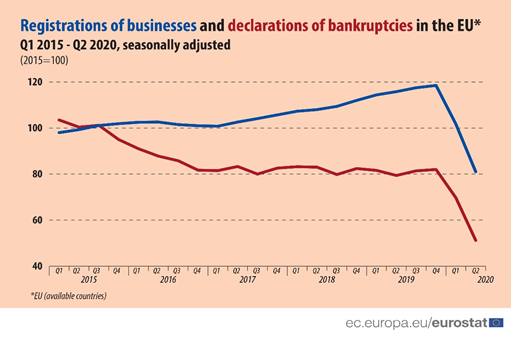
The question is what the size of the proportion of enterprises which is, after the cessation of all types of state subsidies, will, on the one hand, be able to survive by repaying over time the accumulated debts accumulated because of a pandemic. On the other hand, what will be the size of the businesses that will go bankrupt?
In any case, the EU and the respective governments of its member countries should make it possible to restructure the servicing of companies’ debts over time so that more and more companies can get back on their feet.
It is certain that after the completion of the vaccination of the general population at 70% to gain the immunity of the herd, there will be a wave of corporate bankruptcies and rising unemployment.
The size of this rate of bankruptcy and unemployment will depend on whether the restructuring packages for servicing companies’ debts (e.g., multi-year grace periods, etc.) will be generous and at the same time whether these businesses in the first quarter of the smooth transition to economic normality will have liquidity available to continue their business smoothly.
The first companies to go bankrupt will be all those that until before the pandemic had high borrowing relative to their revenues before the advent of the first lockdown (March 2020) while maintaining high wage costs and high fixed costs while during the pandemic (2020) they saw their revenues fall drastically by 70%-80%.
If all these millions of businesses (family, small and medium-sized, large, etc.) at the start of normal economic normality and for the next six months fail to make a dynamic reset while maintaining the minimum possible staff and limited wage costs, then over the next seven to eight years and given the negative interest rates of the ECB, the Eurozone and the EU will experience at least economic stagnant growth, losing enormous ground in the race for global economic-commercial competition.
The strength of the damage done to the economies of the EU member countries and the Western states in general because of the Covid-19 pandemic is proportional – in terms of intensity, extent, duration, and impact – to a world war, which of course its side effects will follow us for many years to come.
