The 1970s
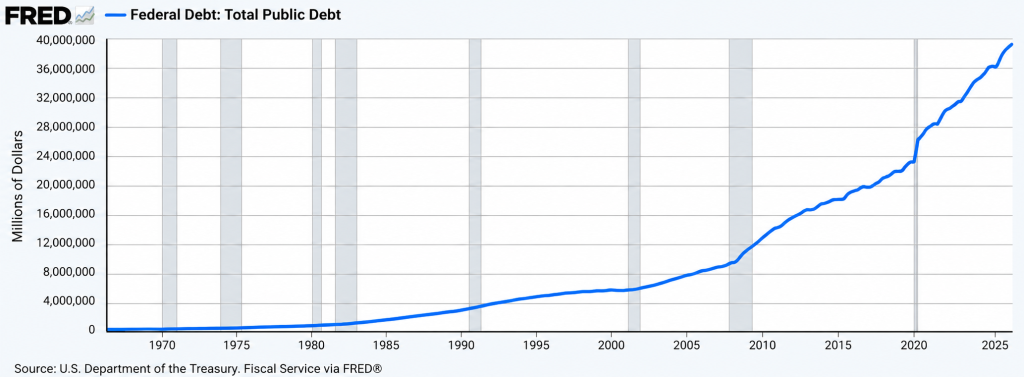
The 1970s was the decade when Nixon severed the link between the dollar and gold, putting an end to the American founders’ vision of a stable and sound monetary system. Backed solely by the “full faith and credit” of the US government, the dollar began a slow but steady decline—dying a death of a thousand cuts: ceaseless borrowing and uncontrolled spending, with little regard for the long-term economic consequences that inevitably follow a debt-fueled binge paid for with dollars created literally out of thin air. To the “experts” of the time, the national debt—standing at $238 billion in 1971—was not a cause for particular concern. After all, any future debts could easily be repaid in that dawn of a generational illusion—what Hemingway described as “temporary prosperity”: a state of excess where the rampant printing of money is passed off as prudent and sensible economic policy. An era devoid of foresight (or restraint) In short, no one in the 1970s was considering what the situation would look like in 2026, when that same national debt would have skyrocketed from a few hundred billion to more than $40 trillion. Instead, American leadership after 1971—whether Republican or Democratic—focused on the next election cycle rather than the purchasing power of the next generation. As the issuer of the global reserve currency, Washington enjoyed what the French Finance Minister had described in 1965 as the “exorbitant privilege” of simply exporting its reserve currency—and its inflation—to the rest of the world. This may have been inherently unfair to the rest of the planet, yet, as the then-US Treasury Secretary John Connally famously put it: “It’s our currency, but it’s your problem.”Buying time with unconventional policies
To ensure this “problem” remained under control, the US effectively compelled OPEC to price its oil in dollars, while simultaneously ensuring that oil producers invested a significant portion of their revenues in US Treasury bonds (USTs). Thus, oil became a crucial “sponge” that absorbed some of our reckless, inflationary spending. And, in case a rise in the price of gold threatened to expose the fact that the dollar was backed by nothing tangible, the Americans also took steps in the mid-1970s to establish a price-setting mechanism on the COMEX; this allowed them to legally influence the paper price of a metal that was far more precious and reliable. Yes. That was the 1970s. What could possibly go wrong? Well… just about everything. Some fifty years later, we now see a world gradually moving away from the dollar—a petrodollar system showing cracks—amidst flying missiles, with the dollar emerging not merely as a global problem but as a problem for America itself.Back to the Future
Let us fast-forward to 2026. The aforementioned “exorbitant privilege” and “temporary prosperity” have now evolved into what Hemingway foresaw as the final stage of this fantasy of borrowing and reckless spending: “ultimate ruin through currency debasement and war.” Naturally, there are proponents of American exceptionalism who would take issue with terms like “ultimate ruin,” dismissing them as the rhetoric of “gold bugs” merely trying to promote their own investment positions. After all, there are so many things supposedly capable of saving us. Look at the S&P 500, hovering at all-time highs. Look at technology. Look at AI. Look at the “milkshake” theory and the immortal dollar. Look at all the brilliant PhDs at the Fed and its magical task forces. Look at stablecoins. Okay. Let’s take a look.The Big AI Bet
As for the S&P 500, it is indeed approaching all-time highs. However, 440 of its 500 constituent companies are trading more than 20% below their 52-week highs. Instead of a truly broad stock market, we have a concentrated minority of tech monopolies propping up the rest of the crumbling edifice with makeshift technological “patches” and memes claiming, “this time is different, thanks to AI.” The dominant tech giants—Google, Amazon, Facebook, and Microsoft—are participating in the largest circular financing and risk-concentration bet the US stock market has ever seen. These hyperscalers derive 70% of their AI-related revenue from just two players: Anthropic and OpenAI—two unprofitable companies whose costs exceed their revenues by billions. These two glaring examples of concentration risk are losing money on a historic scale. Even AI search results themselves confirm the same thing…From concentration risk to circular funding
And if you are wondering how Anthropic and OpenAI are funded, the answer is not that they rely primarily on major venture capital players. In reality, the bulk of their capital—over $700 billion in AI spending alone projected for 2026—comes from the very companies (Microsoft, Amazon, Google, SoftBank, and Nvidia) to which they sell their software, without any real competitive advantage or “moat” against rivals. Even more concerning is that these same tech hyperscalers—which are keeping the two AI ships afloat—are themselves burning through cash at an unprecedented rate to build data centers; the associated costs, along with energy supply issues, are severely straining their cash flows. Given this circular, funded, highly concentrated, and massive volume of capital expenditure—as well as the entire chain of interdependencies—AI is literally evolving into something “too big to fail.” By now, the very survival of the economy and the stock market seems to hinge on a single bet regarding AI—a bet whose profitable future is far from certain—unless the government imposes a protective duopoly regime to keep China out of OpenAI and Anthropic’s backyard. In such a scenario, however, the US would no longer be able to source rare earth elements from Asia…NVDA to the rescue?
But surely Nvidia’s GPU sales will save the day, right? Its results are indeed impressive, and it just announced a 110% revenue increase. Impressive. However, if you take a closer look at Nvidia’s 10-Q filing—and the accompanying notes—you will also see that 70% of its receivables come from just five companies: the ones mentioned above.- Do you see the cyclical concentration risk?
- Do you see the massive bet the S&P 500 has placed on the entire economy—should this AI gamble, priced as if everything were perfect, fail to play out as predicted?
The bond market’s verdict
However, if we shift our focus from a loss-making AI bubble—fueled by a feedback loop of capital and characterized by grotesque concentration and immense uncertainty—to the fragmented US Treasury market, the anxiety is distinctly lower… particularly for a country running annual fiscal deficits of $2 trillion. In reality, when it comes to bonds, the verdict is already clear. We have reached the peak of the madness in the government bond market. With the yield on the 10-year US Treasury (10Y UST) surpassing 5% and public debt standing at $40 trillion, a “death sentence” looms over the dollar’s purchasing power—with a Treasury Secretary powerless to grant a stay of execution. With Scott Bessent having recently added David Zervos and Judy Shelton to his “dream team,” the stage is now set for significant changes—as well as desperate measures—lying ahead. At the same time, Washington figures such as Kevin Warsh avoid giving direct answers regarding how the U.S. government can sustain its interest-servicing costs, or how yields reached 5.25%—up from 4.4% in June, when the current administration took office. Yields rise as inflation rises. Consequently, the conflict involving Iran—which has driven the price of Brent crude to painfully high levels—is the most common explanation for how yields, which stood at 3.9% before the conflict, have now surpassed the critical 5% threshold. However, the real issue—and, in the author’s view, the “smoking gun” behind the rise in these yields—lies in the issuance of U.S. debt at extreme levels, coinciding with a slump in demand to equally extreme lows. As an increasing number of countries—focused on deleveraging—offload US debt to support their currencies or purchase oil amid surging prices, US Treasury yields continue to rise; they will climb even further once the US acknowledges it is already in recession. Global confidence in the US Treasury bond—an instrument that is over-issued, unreliable, debt-laden, and weaponized—has eroded at an accelerating, exponential rate. The premium—or interest rate—demanded by the market to lend money to the US will continue to rise in tandem with expanding fiscal deficits.This is not the bond market we once knew
The once-sacrosanct Treasury market is now mathematically broken—a sign that Washington has effectively lost its composure. Between September 2024 and January 2026, having failed to tame inflation through the aggressive rate hikes of 2022 and 2023, the Fed shifted to a decidedly looser monetary policy, implementing rate cuts totaling 175 basis points. In a normal bond market, such rate cuts would be expected to drive bond yields lower. Instead, yields rose across the entire maturity spectrum of the yield curve. Such yield metrics might seem dull to those unfamiliar with bond market jargon who spend their time endlessly doom-scrolling on their iPhones. Yet, they confirm something critically important: the Fed has lost control over interest rates—and, by extension, the cost of servicing the national debt, the bill for which has now become impossible to pay. And matters are only getting worse. Since 2000, we have witnessed 13 market corrections. In the first 12 of these 13 corrections, the dollar—based on the DXY index—consistently strengthened by at least 8%. However, during the 13th correction last April—when stocks fell by 18%—the dollar declined instead of strengthening, even as bond yields were surging. This is not normal… In this new “abnormal” environment, US Treasuries (USTs) fall when stocks fall, while the over-issued—and consequently undervalued—US dollar fails to strengthen even amidst rising yields. There is no longer a safe haven in the so-called “risk-free return” of a US security. On the contrary, when its yield is measured against actual inflation rather than the Fed’s calculated figure, it amounts to nothing more than “risk without return.” In short, we are operating under a different regime in the bond market. The old rules, correlations, and familiar “tricks” no longer apply. Our bond market is clearly broken. The only way to reduce yields to a sustainable and manageable level is either:- to print money without limit, or
- to carry out a massive debt restructuring.
A credit default masquerading as a “restructuring”?
As for the “restructuring,” the recent addition of Shelton and Dervos is revealing. Shelton, of course, recognizes that US Treasuries have fallen from their pedestal. She knows that a long-term, gold-backed bond possesses greater credibility than a dollar-based security, for the simple reason that the debasement of the dollar is now obvious—and embarrassing—to everyone, including those countries that no longer appear at US government bond auctions. But even a 50-year, gold-backed Treasury bond won’t save the Treasury market. It is too little, too late. The Fed and the Treasury Department will likely try to buy time by implementing a serious yield curve control (YCC) program—issuing more short-term debt in a desperate “Operation Twist 2.0” style attempt to compress long-term yields. But that doesn’t seem to be working very well, does it? The next desperate move could very well be a cleverly designed “restructuring” of government obligations—which, in essence, would be nothing more than a disguised debt default. That is to say, at some point in the future—and in the highly convenient name of “national security,” with the blame naturally placed on a malicious foreign actor or a “black swan” event—Washington could simply announce an extension of bond maturities and the imposition of a 1% cap on their coupons. This would, of course, devastate bondholders—both foreign and domestic—as well as pension funds, insurance companies, money market funds, and the average citizen. It would also trigger a massive drop in bond prices—and likely social unrest—along with a loss of global confidence in U.S. securities. But then again, desperate times call for desperate measures. Under such a “restructuring,” Washington would be forced to halt the issuance of new debt and bring its budget back into balance. It would also mean a sharp drop in the USD—exactly what Washington needs to inflate away its debt and gain some ground on its trade deficit.All roads lead to gold
So, whether we simply click the mouse a few more times to create trillions and bail out—or self-finance—the bond market, or restructure US Treasuries by capping their coupons, the net result is, one way or another, a weakened dollar and, consequently, an explosive rise in the price of gold over the coming years—at least for those capable of looking that far ahead. This further explains why central banks—which are currently accumulating gold at a record pace—now hold more gold than US Treasuries. They see where the dollar is heading—and just how desperate the situation is—and, consequently, they see where gold is heading, too.The impending collapse of the US credit and stock markets is only a matter of time
Artificial intelligence stocks are caught in a vicious cycle of overinvestment—devoid of profits—and constantly shifting narratives; this situation will likely necessitate government regulation to rein in the sector and shield hyperscalers and overvalued AI service providers from a new 2008-style catastrophe, as the impending collapse of the US credit and stock markets is only a matter of time. Based on the telling—yet largely ignored—signals emitted by the anemic, concentrated, and highly leveraged stock market; and based on our openly broken, unsustainable bond market—not to mention the “private credit” time bomb, which is desperate for a liquidity miracle or a policy-driven default that would further devalue the Greenback—the picture is clear. Warsh, Bessent, and Shelton are not going to save this credit market. Neither Santa Claus nor any other miraculous ploy will pull it off. It is simply too late. In fact, the image that comes to mind takes us straight back to the 1970s and those Saturday morning cartoons we watched as children—back when Nixon and his successors were setting in motion the disaster we face today, decades before the dot-com frenzy… US credit, stocks, monetary fantasies, and the ignored realities of Main Street have already gone over the cliff’s edge. We now stand suspended over a fall that is no longer theoretical; it lies directly beneath us.Please follow and like us:
