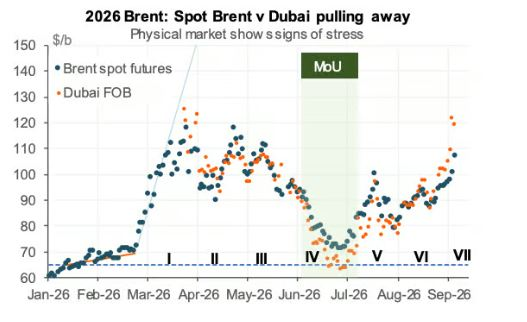
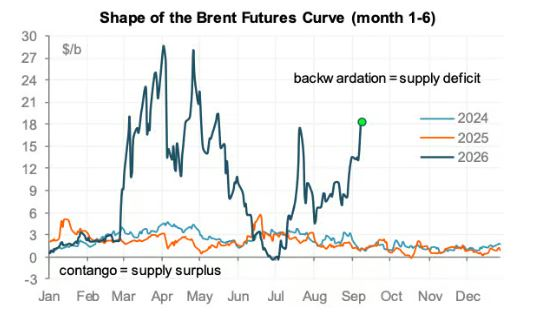
Trust Economics, an economic research and business consultancy firm, noted in a report on September 11 that the physical oil market is now flashing strong warning signals.
Export disruptions, shrinking inventories, and the ongoing diesel shortage crisis are converging just as the market heads into the peak demand period of the fourth quarter.
The decline in Saudi Arabian exports is becoming a major issue. The Kingdom’s crude oil shipments remain at roughly half their normal levels, as Iran-backed Houthi rebels restrict cargo movements in the Red Sea, while shipments via the Persian Gulf remain low.
Overnight, the Houthis seized the Mayan in the Bab el-Mandeb Strait—a development that heightens concerns that commercial shipping in the region could be further curtailed.
Some crude cargoes continue to pass through the Strait of Hormuz via “dark” tanker routes along the Gulf of Oman. However, this partial recovery has not restored regional export levels. Crude oil loadings from the Middle East averaged 13.3 million barrels per day during the week ending September 9, with Tracxn Economics warning that the shortfall amounts to approximately 5 to 6 million barrels per day.
Data on the current state of the Gulf energy market:
The Oil Flow Landscape
Two of the Middle East’s three key maritime chokepoints are constraining oil exports. While the situation may not be officially labeled a “war,” the oil market is behaving as if it were already in the midst of a severe crisis.
Futures contracts have risen by approximately $10 per barrel so far this week, and the market structure has shifted to a strongly bullish stance.
At the same time, Asian natural gas markets are at the forefront of these developments, relying even more heavily on Middle Eastern exports. To make matters worse, rising crude oil prices are now exerting significant pressure on diesel profit margins.
All signs indicate that oil markets have begun to price in serious disruptions.
First, there are no easy or immediate solutions in sight for either the war in the Middle East or the conflict in Ukraine.
Second, it is telling that Washington has not spoken of any “imminent deal” for weeks. In effect, Washington has upended the oil market, leaving the EU and Japan to face the prospect of stagflation in their economies.
Thirdly, the picture of the physical market confirms that there are genuine shortfalls in crude oil supply—in the order of 3–4 million barrels per day—while the supply of diesel available for commercial trade also remains limited.
Suddenly, the problems facing Saudi Arabia have taken center stage in the market. The Houthis have curtailed crude loadings in the Red Sea, while shipments via the Persian Gulf remain at low levels.
Since late July, Saudi Arabia’s total crude oil exports have averaged just 3 million barrels per day—less than half of normal levels.
This week, Houthi attacks and their military advance are heightening the risk that the situation could escalate into a much more protracted crisis. Particularly striking are reports that President Trump twice refused to assist MbS, who had reportedly asked him to bomb the Houthis.
At the same time, the market is revisiting the narrative regarding demand “destruction” during the second quarter. In reality, according to Trust Economics, what was observed was essentially a temporary “suppression” of demand—which is now rebounding—combined with the depletion of inventories; a situation that cannot be sustained indefinitely.
Within the market, the signals are now clear: both market data and actual cargo flows indicate that supply pressures remain intense.