The prospects of the most integrated economy in the world, namely the USA, should be examined from the side of the forces that affect it.
The most fundamental of these forces have to do with changes brought about by economic opportunities, for example reductions in transport and communication costs, changes in comparative advantages, opportunities to exploit economies of scale and learning by doing.
Of course, changes in economic ideas and geopolitical reality are no less critical, especially in the short and medium term. Also, shocks – wars, crises and pandemics – cause changes in the culture of businesses, peoples and politicians, the costs and benefits of cross-border integration. The narrative of cross-border integration, especially trade, illuminates any interactions between these forces.
If anything, the story is about the pursuit of that particular fulfillment. Between 1840 and 2022, the ratio of world trade in goods to world output increased approximately fourfold. However, trade “openness” fluctuates dramatically: the ratio of trade in goods to world output tripled between 1840 and 1913, then between 1913 and 1945 fell by about two-thirds, and tripled again between 1945 and 1990, surpassing the pre-1914 levels.
Two periods
After the collapse of the Soviet Union in the early 1990s, the world economy experienced two periods:
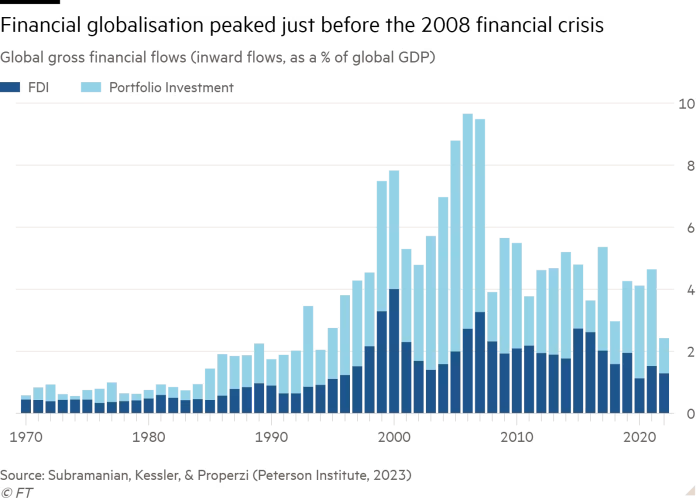
- The first, until about 2010, was the era of “hyperglobalization,” a term coined by Arvind Subramanian and Martin Kessler in a 2013 paper for the Peterson Institute of International Economics (“The Hyperglobalization of Trade and Its Future“). The rapid growth of international trade relative to world output was studied, with cross-border flows of direct capital and portfolio capital growing even faster than trade in goods and services. By the financial crisis of 2007-09, the global economy had become more integrated than ever.
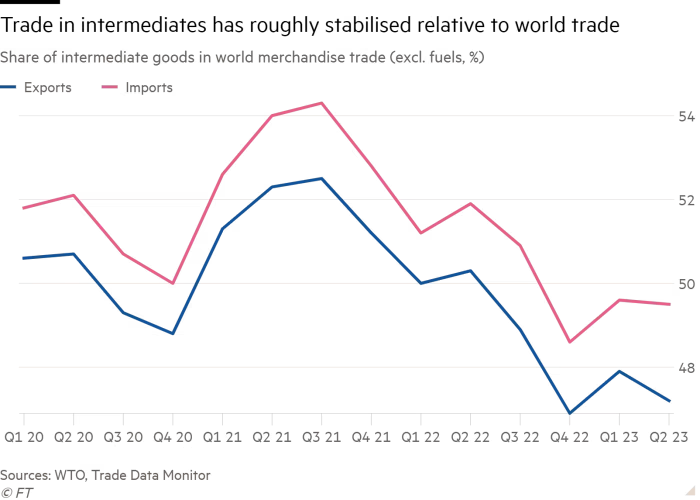
- The world economy then entered a “slowdown” era. Subramaniam and Kessler (with Emanuele Properzi) have analyzed this in a Peterson Institute paper from November 2023 (“Trade hyperglobalization is dead. Long live…?“). In this period, trade grew in line with world output, while cross-border investment to world output ratios were more than halved.
Motive forces
What caused hyperglobalization before the crisis? Why did it end up in slowbalization? What might happen next? The answer to the first question is that, after 1990, three driving forces acted together:
1. Nearly a century and a half of divergent economic growth created huge productivity gaps between the most advanced economies and those that had fallen behind, notably China. This created huge opportunities to utilize cheap labor.
2. Container ships, jumbo jets, and advances in information and communications technology have enabled unprecedented cross-border integration of business organizations and fragmentation of supply chains.
3. Market liberalization and cross-border openness have changed the policies of states. Among the transformative moments were the rise to power of Margaret Thatcher, Ronald Reagan and Deng Xiaoping, in the UK, the US and China, respectively.
In terms of global trade, key points were:
- the completion of the Uruguay Round multilateral negotiations in 1993,
- the creation of the EU single market in 1993;
- the creation of the World Trade Organization in 1995 and
- China’s accession to the WTO in 2001.
What does this period complete?
- All major catalysts weakened or retreated.
- Opportunities for trade increased through the exploitation of differences in labor costs. At the same time, as China’s economy grew, its dependence on trade naturally decreased.
- Also, the crises caused by the pandemic and wars have highlighted the risks associated with an extensive reliance on trade in essential goods.
- Equally important were ideological changes, including the rise of protectionism and nationalism, especially in the US, caused by China’s economic rise and the “China shock” in industrial employment.
- Similar changes have occurred in Xi Jinping’s China.

In this case, politics is shifting: reliance on the free market and private enterprise has, over time, given way to ever-increasing state control.
The most important; The global financial crisis, the pandemic and geopolitical tensions have turned trust into suspicion and risk appetite into risk aversion. No meaningful liberalization of world trade has occurred in more than two decades.
What could come next?
Continuation of the current turbulent status quo seems the most reasonable response. Of course, the global economy will remain relatively open by historical standards, with trade growing more or less in line with global output. There will be some disconnection of direct ties between the US and China.
But the US (and others) attempt to turn to other suppliers will leave an indirect dependence on inputs imported from China. A large number of countries will continue to have trade ties with the US and its close allies on the one hand, and China on the other. The most likely alternative to this would be a more radical collapse.
Efforts to contain US actions against China on national security—Jake Sullivan’s “small yard and tall fence” (“Remarks by National Security Advisor Jake Sullivan on the Biden-Harris Administration’s National Security Strategy“) may turn into a “big yard and tall fence.”
Donald Trump’s victory in the November 2024 US election may act as a catalyst. Clashes over the EU’s carbon border adjustment mechanism could be another trigger for global protectionism. The integrated global economy survives.
But the nationalist rivalry of the great powers can cause enormous upheaval. Will this season prove to be an exception? Let’s see…
